
mGLO — Midas (Multi-chain)
mGLO is a limited-recourse note issued by Aureum Securitisation Fund over a Fasanara private-credit strategy. The main risks are incomplete reserve reconciliation, concentrated credit exposure and limited instant-exit capacity alongside leveraged holder demand. At the 27 October snapshot, the instant facility held $20.96M of shared assets with $384k of cash behind its payout routes; standard withdrawals use a separate admin-settled path, which paid one $7.54M request at NAV after 23 days. Operational powers remain broad despite 48-hour proxy-upgrade timelocks. Fees are fixed when a withdrawal request is created and cannot be increased on an existing pending request. The team reports additional fee limits in development; deployment has not been verified.
Strengths
- Cash settlement has been demonstrated. Request #1 paid $7.54M at full NAV after 23 days; three sister mGLOBAL requests paid $884,631 at NAV on 26 October. The September in-kind holdback was subsequently returned.
- Issuance reconciles to consideration, including the October true-up mint and the 18.49M mGLO minted against $19.07M USDC in the same transactions on 27 October.
- Ethereum and Base proxy upgrades run through verified 48-hour timelocks. The bridge review found four required, named non-issuer verifiers on every reviewed direction and matched credits and debits.
- Yield comes from private-credit carry, with no material token incentives. The sister compartment's selected NAV steps imply 6.52–7.14% using fixed-month compounding; neither series has recorded a negative step. Publication intervals vary, so these are not elapsed-time annualised returns.
Risks & Constraints
- Backing and recourse remain incompletely documented. The public 100% panel uses stale supply; JTC's September figure covers about 97% of liabilities on minted units, or about 94% including owed true-ups. This is an unresolved reconciliation, not demonstrated insolvency. The investment strategy concentrates exposure in one fund chain, and mGLO-specific ranking and enforcement terms are unpublished.
- Instant liquidity is shared and capacity-limited. The $20.96M facility serves 15 products; $384k is shared cash behind payout routes, not guaranteed executable output. The 10% reference consumes about 70 full daily allocations on one listed swapper, assuming exclusive cap access and refills. Standard withdrawals settle separately and are not subject to that instant cap.
- Operational powers remain broad. Proxy upgrades have a 48-hour timelock, but role grants, settlement rates, vault withdrawals and pricing pointers can change without that delay. The controller Safe has a one-signature threshold; the vault admin is analyst-confirmed 2-of-4 MPC. Fee changes affect newly created requests, not existing pending withdrawals; a new transaction can still execute at a fee different from its earlier preview.
- Leveraged and concentrated holders can amplify exit demand. Third-party Morpho borrowers owe $91.26M against 76.76% of mGLO supply, while the top ten economic owners hold 82.49%. This is borrower debt, not issuer leverage. No liquidation or bad debt was observed, and the three large October depositors have no established common-control link.
Verdict & conditions
Tier 4 — Elevated Risk. The APB composite is 3.12, with General at 2.62, Asset at 3.22, Protocol at 3.47 and Blockchain at 3.00. Asset and Protocol each take the 1.5× track-weight penalty for exceeding 3.0. No area is graded F in this assessment, and the F-gate passes.
mGLO combines off-chain private credit with an on-chain borrowing market that is much larger than its readily funded exit. There is evidence of matched issuance and cash redemption at NAV. Those facts do not establish full independent reserve coverage, a committed exit facility or bounded administrative powers.
Eight areas grade D: reserve verification in General; holder concentration and contract powers in Asset; risk management, dependencies and governance in Protocol; and decentralisation and client diversity in Blockchain. These weaknesses outweigh the demonstrated cash settlements, matched issuance and 48-hour proxy-upgrade timelocks.
The fee assessment is C: fees are fixed when a withdrawal request is created, so later changes cannot charge an existing pending request. A new request remains exposed to a fee change between preview and execution because it has no caller-enforced maximum fee or minimum net amount. Additional limits are in development and receive no credit as deployed protection.
Conditions to revisit:
- Reconcile an administrator-backed reserve statement to current supply, with at least 100% coverage and supply within 5% of the on-chain census. Publish compartment ranking, recourse and settlement-form terms.
- Reassess liquidity if funded payout stays below one daily cap for more than 72 hours while exits are queued, if stated capacity falls below the $14.15M reference, or if a cash request is refused or settled in kind without agreement.
- Escalate on Morpho debt above 5× the stated capacity ($104.8M at this snapshot), any liquidation, or collateral concentration above 80% of supply. Debt is already 4.35× capacity, leaving limited room before that next escalation threshold.
- Review any listed token-fee change for disclosure, execution-time protection and realised charges; do not confuse a published fee on a new request with repricing pending escrow. Reassess on an unexpected charge, a new Base client-bug halt or a negative NAV step. Credit the planned fee fix only after its deployed scope and any role-admin bypass are checked.
- Monitor the November NAV round. Without a new round, the guards fail closed on 22 December 2026 at 11:40 UTC. The reserve-evidence down-trigger and the pending sister request review are dated 30 November 2026.
Overview
| Item | Assessment |
|---|---|
| Position | Limited-recourse note issued by Aureum Securitisation Fund, Compartment mGLO; holder ranking and enforcement terms unpublished |
| Underlying | MGLOBAL FUND, a sub-fund of Fasanara Investments SA SICAV-RAIF, with Ascender Fund Partners as AIFM; exposure ultimately reaches Fasanara's Global Diversified Alternative Debt Fund (GDADF) |
| Economic return | SME asset-backed credit and trade receivables, recognised through a monthly appraised NAV; no derivatives funding or basis-trade leg |
| Issuance | Greenlisted subscriptions through deposit vaults, operator mints matched to consideration, and LayerZero mint/burn transfers; no effective supply cap |
| Instant exit | Greenlisted route through the shared Midas Instant Liquidity facility (MSL), at NAV × 0.98 less a 50 bps fee; each listed swapper shares a 200,000 mGLO limit among all users per UTC day |
| Standard exit | Fee charged and net token amount stored at request creation; later fee changes do not affect it. Separate admin-settled route, no holder cancellation and discretionary settlement rate; request #1 paid cash at NAV after 23.04 days |
| Fund liquidity | GDADF quarterly redemption with 45/60 days' notice; this is distinct from the token's instant-redemption facility |
| Chains | Ethereum 18.593%, Base 55.797%, Robinhood Chain 25.609%, and 0.20 mGLO on Optimism at the 27 October census |
Key metrics
Unless stated otherwise, figures are observations from 27 October 2026, around 13:36–13:40 UTC. Capacity comes from the analyst-supplied first-party capture on 26 October and the subsequent state review.
| Metric | Value | Evidence basis |
|---|---|---|
| Total supply | 139,936,367.51 mGLO; approximately $141.53M at published NAV | All-chain on-chain census |
| Chain balances | Ethereum 26,018,892.04; Base 78,080,589.78; Robinhood 35,836,885.50; Optimism 0.20 | On-chain census |
| Published NAV | 1.01137228, last round 23 October at 11:40 UTC; +0.5574% over 28.11 days | Seed feeds and guard reads |
| Public reserve panel | $63.20M gross AUM = $63.20M token value, presented as 100%; based on 62.49M units, the 28 September supply | 23 October attestation and supplied panel capture |
| Administrator figure | $115,994,382.57 at 30 September; 96.92–97.46% of liabilities on minted supply, or 93.82–94.34% including owed true-up units | JTC statement; supply and obligation sensitivities below |
| Instant redemption capacity | $20.96M: Ethereum $20.23M, Base $736.41k, Robinhood $0.07 | Midas Liquidity Profile capture; shared facility stock |
| Cash behind instant payout routes | $384,152: Ethereum $8,411.68 and Base approximately $375,740 | Shared second-leg cash stock at the snapshot; actual output also depends on limits, allowances and other users |
| Subscription cash awaiting transfer | $25.95M USDC at the Base receiver at 13:37 UTC on 27 October | October-window subscriptions, separate from instant-route cash; not assumed already deployed into GDADF |
| Reference exit | 13,993,636.75 mGLO, approximately $14.15M; 10% of supply | Derived from the census and NAV |
| Instant throughput | 200,000 mGLO per listed swapper per UTC day, shared by all users; about 70 full cap allocations for the reference on one route, 35 with both | Capacity-only arithmetic assuming exclusive cap use, sustained funding and access to both chains; not a standard-request waiting period |
| Fees | Instant fee 50 bps; listed USDC token fee 0 bps; no timelock on either setter | Verified source and governance event review |
| Morpho exposure | $91,259,249 debt on 107,408,268.51 mGLO, 76.76% of supply; 4.35× stated capacity | Seven mGLO markets; no liquidations or bad debt observed |
| Base x0.98 market | 42.8% of collateral, $40.00M debt; no oracle-to-rail buffer before fees; aggregate LTV implies 4.07% collateral-value headroom to LLTV | Market beginning 0xe0cda5bc; individual borrowers can liquidate sooner |
| Ownership | Top ten economic owners 82.49%; largest owner 17.64%; control-view top ten 95.21% | Pooled-vehicle look-through and clustering review |
| NAV step rates | mGLO 6.42% and 6.90%; sister 6.52–7.14%; no negative step across 21 rounds | Each selected increment compounded over 12 months, treating it as one month's return; approximately zero incentives |
Economic model & what you are holding
The note's investment strategy follows Aureum's mGLO compartment → MGLOBAL FUND → Fasanara GDADF → SME credit and trade receivables. The administrator's statement identifies the holding as the Class A USD accumulation share of MGLOBAL Fund, SF36. This concentrates the investment strategy in one manager, one AIFM and one fund chain; it does not mean every dollar was already invested off-chain at the snapshot. The source records $25.95M of October-window subscription USDC still at the Base receiver at 13:37 UTC on 27 October, awaiting onward transfer.
Subscriptions pass through a vault receiver to payment and off-ramp accounts before reaching the fund off-chain. The source traces matched consideration for every issued unit, including both the 23 October true-up and subsequent October-window subscriptions. Matching a mint to a payment establishes consideration at issuance; it does not independently establish the present value or legal ownership of the off-chain assets.
| Token or asset | Role | Holder implication |
|---|---|---|
| mGLO | Compartment note with NAV accrual | Gated redemption; ranking and recourse unpublished |
| mGLOBAL | Sister compartment over the same SF36 class | Useful settlement and yield evidence, but a separate wrapper whose outcomes do not guarantee mGLO's |
| wmGLO | Ethereum wrapper used as Morpho collateral | Pass-through exposure; unwraps into mGLO |
| mTBILL / mLIQUIDITY in MSL | Second-leg assets used to fund instant redemptions | Shared liquidity stock, not cash reserved exclusively for mGLO |
Yield is credit accrual. The selected NAV increments are positive and similar in size, with no material emission programme. The quoted 6.42%/6.90% for mGLO and 6.52–7.14% for its sister use (1 + each step's return)¹² − 1, treating every selected increment as exactly one month's return. Actual publication intervals vary, including approximately 24–45 days in the sister series. These rates therefore do not establish stable returns per elapsed day or realised cash yield. The return depends on appraised credit assets rather than an independently reconciled stream of cash distributions. Borrowing and looping by holders are assessed under Protocol 7; they are not themselves token incentives.
Loss absorption and recourse are incompletely documented. No on-chain first-loss buffer is codified. Midas describes drawn MSL loans as senior to mToken-holder equity; the mGLO-specific priority of payments and enforcement terms were not available to verify that claim. The structure is described as compartmentalised, but this does not by itself establish noteholder seniority within mGLO. Missing published terms are not proof of no legal rights or zero recovery. The manager's reputation and regulatory status do not substitute for the issuing vehicle's terms.
Top risks, ranked
Ranked qualitatively by potential holder loss and exit disruption. Several mechanisms overlap; the ranking does not estimate probabilities or add exposures together.
| # | Risk | Mechanism | Scope and qualification |
|---|---|---|---|
| 1 | Backing reconciliation and concentrated private credit | One investment-strategy chain, unpublished mGLO ranking and enforcement terms, and administrator figures that do not reconcile fully under every liability basis | JTC alone covers about 97% on minted units or 94% including owed true-ups. This is a reconciliation and recoverability concern, not demonstrated default or insolvency; some subscription cash had not yet been invested |
| 2 | Shared instant liquidity and discretionary standard exit | $20.96M of shared facility stock versus $384k cash behind instant routes; each listed mGLO swapper shares a 200k mGLO cap across users per UTC day | The reference consumes about 70 full cap allocations on one route, assuming exclusive access and refills. Standard requests are separate: one paid $7.54M at NAV after 23 days, but timing and settlement remain administrator-controlled |
| 3 | Broad operational and role authority | One-signature controller Safe plus a parallel role admin; immediate role grants, settlement parameters, vault withdrawals and pricing-pointer changes | Proxy upgrades retain a real 48-hour delay. Runtime powers do not. Vault-admin custody is analyst-confirmed 2-of-4 MPC; that is not an on-chain limit on its function scope |
| 4 | Leveraged and concentrated holder demand | Third-party borrowers owe $91.26M against 76.76% of supply, 4.35× shared facility stock; top ten economic owners hold 82.49% | These are borrower debts, not issuer leverage. Deleveraging can amplify competition for exits, but no liquidation or bad debt was observed and no common-control link was established among the three large October depositors |
| 5 | Single-source NAV and dealing interruptions | One publishing authority and no independent fallback; appraised values can lag losses, while stale or out-of-band feeds halt the affected route | The reviewed guards reject stale or out-of-bound values; they cannot verify the economic accuracy of a fresh, in-range NAV or provide another price. Pricing-pointer authority is covered in rank 3 |
| 6 | Chain concentration and bridge configuration | Base holds 55.8% of supply; Robinhood holds 25.6%, with a filtering constraint and no funded local exit. Bridge configuration remains mutable and inbound mint uncapped | The reviewed bridge directions require four named non-issuer verifiers and reconcile credits with debits. Strong current verification does not remove chain availability or configuration risk |
| 7 | Fee changes before a new standard request executes | A holder can inspect confirmed fees before submitting, but a change executed first can invalidate that preview because the request has no maximum-fee or minimum-net guard | Fee is fixed at creation: existing pending withdrawals are not recharged. Historical listed token fee was zero; no abusive charge was observed. The team reports additional limits in development, not verified as deployed |
General DD
General composite: 2.62. Named management, verified contracts and a credit-funded return support the assessment. Independent reserve verification is the weakest area. Governance protection is uneven: proxy upgrades are delayed by 48 hours, while operational role changes and privileged calls remain immediate.
| # | Area | Grade | Observation | Qualification |
|---|---|---|---|---|
| 1 | Governance & access control | C | Verified 48-hour proxy-upgrade timelocks, proposed and executed by a 1-of-3 Safe | Operational role changes remain outside the timelock |
| 2 | Smart contract security | B | Reviewed implementation bindings corrected; several Base deployments match reviewed Ethereum builds | Full commit-pinned audit coverage of the deployed suite is not established |
| 3 | Oracle security | C | Fail-closed guards with 60-day staleness and 0.90–1.10 bounds | Single publisher, no fallback, admin-controlled feed logic |
| 4 | On-chain financial audit | D | Supply reconciles, but the public 100% panel uses stale supply and does not independently verify the AUM input | JTC alone covers about 97% on minted units, or about 94% including owed true-ups |
| 5 | Team reputation & transparency | A | Named Fasanara and Midas leadership support the team assessment | Directors or managers of the mGLO issuing vehicle are not disclosed first-party |
| 6 | Economic design | B | No emissions and a non-reflexive receipt model, with operator-exclusive NAV propagation | Return depends on appraised private-credit assets and operator-published NAV |
Asset DD
Asset composite: 3.22, with the track-weight penalty. Two rows are D, five are C and one is B. Holder concentration and broad contract powers are the principal weaknesses; incomplete reserve reconciliation, shared liquidity and unpublished noteholder terms constrain the remaining assessment.
| # | Area | Grade | Observation | Grade basis |
|---|---|---|---|---|
| 1 | Asset mechanism & design | C | Matched issuance and a cash redemption at NAV; JTC alone covers 96.92–97.46% on minted supply, or 93.82–94.34% including owed true-up units | Issuance and settlement work; reserve ownership and liability reconciliation remain incomplete |
| 2 | Ownership & supply distribution | D | Top ten economic owners 82.49%, largest 17.64%; eight of the top ten are leveraged borrowers | Above the roughly 70% top-ten bound; no evidenced owner or cluster above 30% |
| 3 | Liquidity & market depth | C | $20.96M shared facility stock versus a $14.15M reference; $384k cash behind instant routes and about 70 full cap allocations on one swapper | Grade uses shared facility capacity; instant execution is constrained by cash and caps. Standard requests settle separately |
| 4 | Volatility & price behaviour | C | Appraisal NAV series with positive steps, no market venue and no independent price discovery | Appraisal-based series without a stress record; the September holdback was returned |
| 5 | Smart contract implementation | D | Verified code, but uncapped mint, seizure-burn, vault withdrawal, settlement and feed powers | Powers are not bounded or delayed; no demonstrated loss from them |
| 6 | Incentives & sustainability | B | Approximately zero incentives; positive booked credit increments, quoted using fixed-month compounding | Credit income supports returns without token subsidies; independent fund-level coverage remains incomplete |
| 7 | Dependencies & external risks | C | Investment strategy concentrates exposure in one fund chain; cash settlements support the manager assessment, while some subscription cash remained on-chain | Named counterparties and observed settlement support C, with low confidence given the concentrated exposure |
| 8 | Regulatory & issuer risk | C | Manager is identified; issuer is not CSSF-authorised and noteholder terms are unpublished | Manager reputation supports the assessment; issuer-specific rights remain insufficiently documented |
Reserve coverage: what the 100% panel establishes
The 23 October public panel presents $63.20M gross AUM against $63.20M token value, or 100% coverage. The source review reconstructs that number as 62,490,439.78 mGLO × NAV 1.01137228. The units match the all-chain supply on 28 September and represent only 52.81% of the 118.33M units on chain at the panel's own 23 October anchor. No separate attestation covers the remainder in the source review.
The panel's verification checks signatures, the claim graph and workflow provenance. The reviewed workflow does not independently validate the AUM input, and this attestation contains no fund-manager claim. Its 100% result should therefore not be read as independent evidence that current liabilities are fully backed.
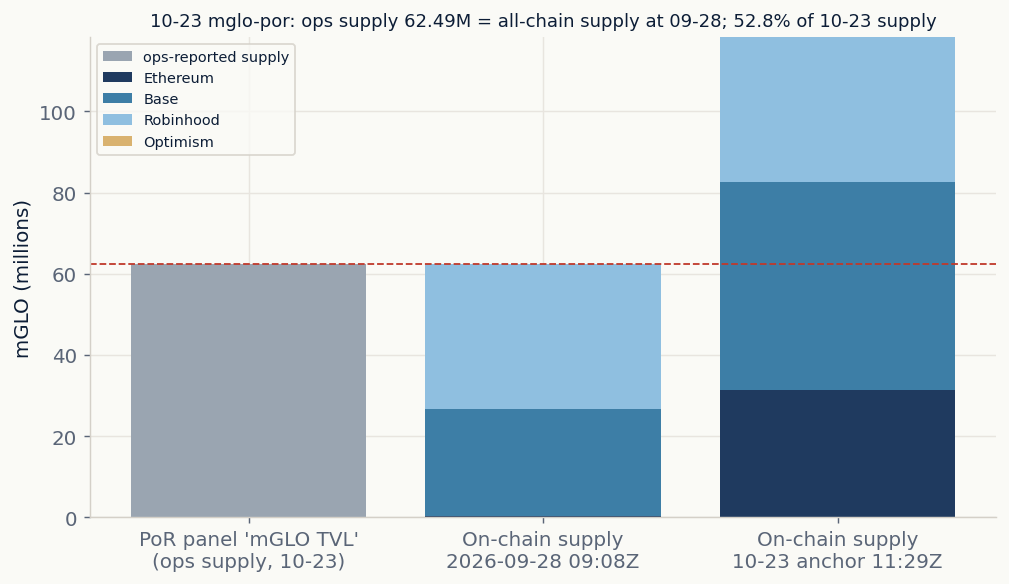
A separate JTC statement gives $115,994,382.57 of fund value at 30 September. Coverage depends on whether the liability denominator includes only units already minted at that date or also 3,917,504.12 true-up units owed for the September holdback and subscription buffer, subsequently minted on 23 October. Each range below uses the NAV in force on 30 September and the later struck NAV.
| Liability basis at 30 September | JTC fund value alone | JTC plus $4,514,750 receiver USDC |
|---|---|---|
| 118,333,564.15 units already minted | 96.92–97.46% | 100.69–101.25% |
| Minted units plus 3,917,504.12 owed true-up units | 93.82–94.34% | 97.47–98.01% |
No class document assigns the receiver cash to the compartment, and it later funded request #1. Even counting that cash, the owed-unit scenario leaves $2.45–3.13M between candidate assets of $120.5091M and liabilities of $122.9560–123.6413M. Without owed units, JTC alone leaves a different gap of $3.02–3.68M. The ownership of candidate assets and the correct unit/NAV basis remain unresolved; these are reconciliation scenarios, not a demonstrated loss after every eligible asset and obligation is established.
Asset 1 is graded C, reflecting matched issuance and demonstrated cash settlement alongside the unresolved backing evidence. A current administrator-backed attestation, compartment ownership evidence and a reconciled supply basis are needed to resolve the discrepancy.
Exit: capacity, cash and throughput
The three measures answer different questions. $20.96M is the first-party capacity used for grading, corresponding to shared facility stock. $384,152 is the cash stock observed behind the second-leg instant-payout routes, not total issuer reserves or guaranteed output executable in one transaction. 200,000 mGLO per listed swapper per UTC day is the instant throughput limit, shared by all users of that swapper. The facility serves 15 Midas products and has no mGLO-specific refill commitment identified in the reviewed material.
| Route | Pricing and access | Funding / throughput | Observed limitation |
|---|---|---|---|
| Listed instant swappers | Greenlisted; NAV × 0.98 less 50 bps, approximately 2.49% below NAV | Each swapper shares 200,000 mGLO per UTC day across all users | Reference uses about 70 full daily allocations on one route or 35 across both; assumes exclusive cap access and refills. Snapshot cash stock is 2.7% of the reference |
| Standard request | Greenlisted, admin-settled; token fee charged at creation, zero at snapshot | Issuer-arranged cash; instant daily cap does not apply; no holder cancellation | Request #1 paid at NAV after 23.04 days; pending net amount is not re-feeable, but settlement rate remains discretionary |
| Robinhood local exit | Local swapper unwired at the snapshot | Approximately $0.07 local capacity | No funded local exit for 25.6% of supply |
| Open market | No aggregator route evidenced | No meaningful DEX depth | Does not support a reference-size exit |
Asset 3 is graded C on the stated facility capacity. That stock does not establish executable daily liquidity: the counter resets at UTC day boundaries, and the figures above are cap allocations, not elapsed-day guarantees. Competition, exhausted allowances or delayed refills can extend the exit; using both chains also requires access to both routes. Standard requests bypass the instant daily cap and rely on separate issuer settlement. The successful $7.54M standard redemption came from issuer cash rather than MSL and does not demonstrate that MSL can fund an exit of that size.
Protocol DD
Protocol composite: 3.47, with the track-weight penalty. Three rows are D and five are C. Immediate operational powers, discretionary risk controls and dependence on a single NAV source dominate this track. Successful settlements establish a working redemption mechanism, with a short operating record and limited stress evidence.
| # | Area | Grade | Observation | Grade basis |
|---|---|---|---|---|
| 1 | Protocol design & mechanics | C | KYC-gated dealing; successful cash requests; no holder cancel and discretionary approval rate | Working cash settlement with material administrator discretion over completion |
| 2 | Proven model & lineage | C | Public Midas framework with about 2.87 years of production history; mGLO itself approximately four months old | Short token-specific record and no separately established commit-pinned audit of the deployed suite |
| 3 | Fee structure & economic model | C | Fee fixed at new-request creation, with no later fee recalculation on pending requests; standard requests do not enforce a caller-specified maximum fee at execution; instant requests enforce minimum-out | Prospective dealing terms with exposure between preview and execution; additional limits are not verified as deployed |
| 4 | Operational history & stress performance | C | No NAV markdown, bad debt or liquidation; September holdback returned and cash requests settled | Successful remediation and cash settlement; no published settlement-form policy or exogenous stress test |
| 5 | Liquidation & risk management | D | Rail parameters change immediately; no codified on-chain first-loss buffer | Domain checks do not bound the administrator's economic discretion |
| 6 | Dependency chain | D | One manual NAV source, mutable guard pointers and no independent fallback | Critical single point of failure; fail-closed guards are a circuit breaker |
| 7 | Integration & composability risk | C | $91.26M debt, 76.76% of supply collateralised, 4.35× stated exit capacity | Concentrated leverage with no observed liquidation or bad debt; escalation at 5× capacity or any liquidation |
| 8 | Governance attack surface | D | 48-hour proxy upgrades, but a 1-of-3 controller Safe and parallel role admin outside the delay | Fund, fee, role and bridge-configuration powers remain immediate |
Fee timing: new requests versus pending withdrawals
Fees are fixed at request creation. A standard withdrawal has two stages. At creation, _redeemRequest calculates the current token fee, transfers that fee and stores the net mGLO amount. At later approval, _approveRequest uses the stored amount; it does not calculate the token fee again. Changing changeTokenFee therefore does not charge an already-created pending withdrawal or reduce its escrow through a new fee. Settlement-price and withdrawal powers are separate controls, discussed under governance.
A holder can inspect the confirmed fee before choosing to submit a new request. A transaction waiting for inclusion is different from a request already stored on-chain: the former has not fixed its fee yet. The standard redeemRequest has no caller-supplied maximum fee, minimum net amount or deadline, so a fee change executed before request creation can invalidate an earlier off-chain preview. This is an execution-time protection gap, not evidence of an observed attack or loss.
The 99.99% simulation changed the token fee first and then created a new 1M mGLO request, charging 999,900 mGLO at creation. It did not reprice an existing pending request, reproduce a live-user loss or measure the amount of real transactions exposed between preview and inclusion. The listed token fee was zero at the assessment snapshot, with no fee-setter events observed there.
setInstantFee is separate: it affects instant operations, which enforce the holder's minimum received amount, and cannot charge standard requests. A simulation setting it to 100% took none of a new 1M mGLO standard request. Account fee waivers lower the fee for selected accounts; they do not impose a fee on pending escrow.
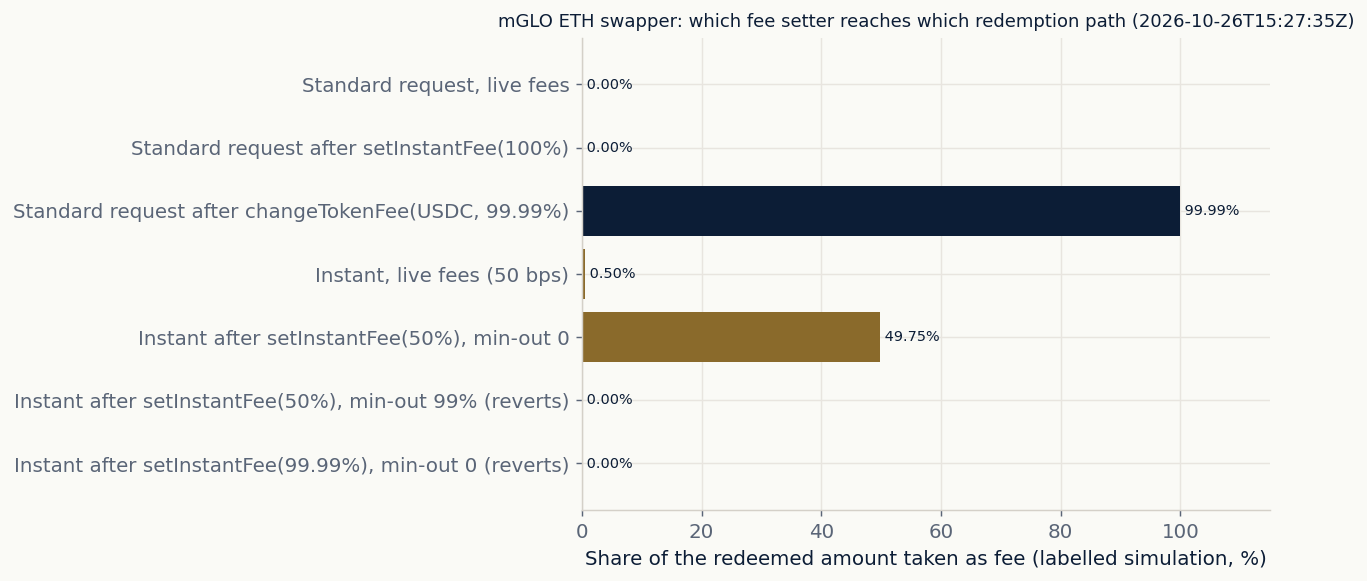
Remediation. The team reports additional fee limits in development as of 2 November. The mechanism, deployment date and coverage have not been verified. Effective protection must cover the standard-request token fee and any bypass through role administration; an instant-fee timelock alone would not address this path. The rating gives no credit for an undeployed limit.
On 26 October the vault admin also waived fees for 12 accounts on the unlisted profile swapper; one exited 9,424.75 mGLO at NAV with no fee or cap. Those preferential terms are a governance and access issue, distinct from retroactive fees on pending requests.
Leverage and the exit facility
Morpho borrowers owe $91.26M against 107.41M mGLO collateral. That is 4.35× the stated $20.96M shared facility stock and 237.6× the snapshot cash behind instant routes. These are stress-unwind comparisons, not measures of issuer leverage or forecasts that all debt will liquidate together. The shared facility also serves other products, and the mint leg is uncapped.
The new Base market beginning 0xe0cda5bc holds 42.8% of all mGLO collateral, with $40M debt. Its oracle values collateral at the same NAV × 0.98 rate used by the redemption route, leaving no buffer before the 50 bps fee. Its aggregate LTV implies a 4.07% collateral-value markdown to the liquidation threshold, but Morpho liquidates individual borrowers, which can reach that threshold sooner. The weakest large borrower sampled in this Base market has a health factor of 1.0386, implying about 3.71% headroom with debt held constant. Across the reviewed positions, the weakest large borrower is on Robinhood, with a health factor of 1.0228 and about 2.23% headroom. No liquidation or bad debt has occurred in the reviewed record.
The oracle haircut and the liquidation incentive are different. At 91.5% LLTV, the reviewed Morpho formula gives a liquidation incentive factor of approximately 1.02617. At equal oracle and pre-fee redemption rates, multiplying by the 0.995 fee factor implies roughly 2.10% theoretical gross margin per dollar of debt repaid. That is before gas, financing costs, price changes and delays, and assumes eligible access, funded liquidity and available daily capacity. It is neither an execution quote nor a guarantee of profitable liquidation. The zero additional oracle haircut does not mean zero borrower collateral headroom or zero liquidator compensation.
Protocol 7 is graded C with debt already above 4× shared capacity. The next escalation threshold is 5× capacity, or $104.8M at the snapshot, and any liquidation independently triggers reassessment. The absence of realised bad debt does not establish that the exit facility could absorb a stressed unwind.
Settlement history and NAV controls
The strongest exit evidence is mGLO request #1: 7,457,000.29 mGLO settled for 7,541,803.39 USDC at NAV 1.01137228 on 23 October, after 23.04 days. Sister mGLOBAL requests #4–#6 paid 884,631.43 USDC at NAV on 26 October, above their stored rate, after approximately 31–33 days.
The sister's September cash requests had instead been delivered in mGLO with a 7% holdback. That holdback was returned on 23 October, bringing value to 1.00012 of NAV. The remediation is favourable; the absence of published cash-versus-in-kind settlement terms remains a weakness. Sister request #10 was still pending on 27 October.
NAV is written by one feed-admin address. Listed vault prices were re-pointed on 19 October from NAV × 0.93/1.07 to × 0.98/1.02 without an event, delay or public notice in the reviewed record. The last seed round is 23 October. Guards fail closed on stale or out-of-band adjusted prices, rather than switching to another source. At the reviewed settings, the redemption lower-band threshold corresponds to raw NAV below approximately 0.91837, and the deposit upper-band threshold to raw NAV above approximately 1.07843. The separate staleness condition is 60 days without a fresh round.
Blockchain DD
Blockchain composite: 3.00, without a track penalty. Rows 1, 2 and 4–8 use the 16 October float census; Client diversity uses the 27 October census. Robinhood's restricted escape route and Base's majority share with limited client diversity are the principal weaknesses.
Census sensitivity. Blockchain 8's B rests on Ethereum holding more than 25% of float on 16 October. Its 27 October share of 18.593% crosses that row's downgrade threshold. Applying the newer census to this row gives C, a Blockchain composite of 3.11 and an APB composite of 3.13 after the track penalty, still Tier 4. The published 3.12 composite uses the census dates stated above.
| # | Area | Grade | Observation | Grade basis |
|---|---|---|---|---|
| 1 | Decentralisation & validator set | D | Robinhood has one filtering key and force-included transactions can still fail | Material-chain cap for no working escape hatch; Ethereum and Base retain exits |
| 2 | Consensus & security model | B | Ethereum A, Base B, Robinhood C; Robinhood has a permissioned validator whitelist | Float-weighted result on the 16 October census |
| 3 | Client diversity | D | Base holds 55.797% of supply; its per-chain D binds the row | Limited client diversity and previous client-bug halts; subsequent patch and preserved L1 safety support D |
| 4 | Uptime & reliability | C | Ethereum A, Base D, Robinhood C; Base transaction drops and proposal halts in the reviewed record | Float-weighted result on the 16 October census |
| 5 | Maturity & ecosystem | B | Ethereum mature, Base established, Robinhood only 107 days old at the initial review | Float-weighted result on the 16 October census |
| 6 | Validator behaviour | C | Single Base sequencer; live Robinhood filtering and linked funding of its filterer and active proposer | Concentrated operator control |
| 7 | Bridge security & cross-chain | C | LayerZero mint/burn OFT; four required non-issuer verifiers per reviewed direction; credits match debits | Inbound mint uncapped; peer, verifier and library settings change without delay |
| 8 | Regulatory & jurisdictional | B | Ethereum A; Base and Robinhood C, with concentrated US operators | Retained on the 16 October census, when Ethereum held more than 25% |
Client diversity is D because Base holds a majority of supply. At 55.797% of float, Base's per-chain D binds the row even though the weighted numerical anchor alone would be C. Base experienced client-bug halts on 25 and 26 June. The D assessment recognises the subsequent patch and preserved L1 safety while retaining the availability and concentration risk. A further client-bug halt triggers reassessment.
Improvement to C requires Base at or below 50% of float and Ethereum above 16.667%. At the 27 October balances, that means approximately 8.11M units moved off Base or 16.22M burned there. These are threshold calculations, not an assumed future change.
Bridge verification and configuration authority are separate. The reviewed LayerZero directions require four named non-issuer verifiers and reconcile credits to debits. The Safe can still change peers, verifier sets and libraries immediately, and inbound minting is uncapped. Optimism's 0.20 mGLO deployment is not listed in the reviewed first-party registry. Robinhood has no funded local redemption route.
Legal structure & counterparties
| Entity | Role | Assessment at the source date |
|---|---|---|
| Aureum Securitisation Fund, Compartment mGLO | Luxembourg issuer; LEI 391200M2JHLV9OZAZN78, RCS O136 | Not CSSF-authorised; mGLO ranking, trustee, enforcement and settlement terms unpublished |
| MGLOBAL FUND / Fasanara Investments SA SICAV-RAIF | Fund holding the exposure | AIFM Ascender Fund Partners; administrator statement identifies SF36 Class A USD accumulation shares |
| Fasanara Capital Ltd | Strategy manager; Companies House 07561210 | Named leadership and first-party FCA FRN 551020; regulator-primary confirmation was not obtained by the source review |
| Midas Software GmbH | Platform and site operator | Distinct from the Aureum issuer; its base prospectus for other mTokens excludes mGLO |
| JTC | Administrator evidence | September fund value received through a notarised email claim; not yet consumed by the public mGLO attestation |
| Midas Instant Liquidity facility | Shared instant-exit liquidity | Availability-dependent; no mGLO refill commitment identified. Midas describes drawn loans as senior to mToken equity; mGLO-specific enforceability was not verified |
The source identifies Fasanara founder and CEO Francesco Filia and named Midas management. The directors or managers of the mGLO issuer are not disclosed first-party. Aureum Manco and the purpose-trust ownership structure appear in third-party material only and are not treated as verified holder protections.
Subscription and payout traces pass through third-party payment hubs and custody accounts whose identities are not fully disclosed. The same custody-undisclosed wallet funded both the mGLO receiver and the sister redeemer. No on-chain evidence establishes that the three large 27 October depositors share control, and the holder analysis does not label them operator-linked.
Privileged roles & contract inventory
Ethereum and Base proxy upgrades run through 48-hour timelocks, covering nine reviewed mGLO proxies per chain. Robinhood's upgrade terminal was identified, but its complete contract inventory and source verification were not performed. The delay on proxy upgrades does not extend to operational role grants or ordinary privileged calls.
| Actor | Address | Authority | Delay |
|---|---|---|---|
| Controller Safe, 1-of-3 | 0xB60842E9DaBCd1C52e354ac30E82a97661cB7E89 | Upgrade proposals and execution; role administration; OFT owner and delegate | 48 hours for upgrades; none for roles or OFT configuration |
| Vault admin, analyst-confirmed 2-of-4 Fordefi MPC | 0x2ACB4BdCbEf02f81BF713b696Ac26390d7f79A12 | Fees, waivers, withdrawal, settlement rates, limits, rejection and pause | None |
| Parallel role admin, custody undisclosed | 0xd4195CF4df289a4748C1A7B6dDBE770e27bA1227 | Grants any mGLO role | None |
| Mint / burn / pause operator, custody undisclosed | 0xA13f82F679E24ad08E014F8af6EcE32023b14F07 | Uncapped mint, governed burn and token pause | None |
| Feed admin, custody undisclosed | 0x83b573AA8C4b567c0466c9d5e32D6513676d795b | NAV publication, pricing pointers and profile feeds | None |
| Ethereum timelock | 0xE3EEe3e0D2398799C884a47FC40C029C8e241852 | ProxyAdmin ownership | 48 hours |
| Base timelock | 0x9230F9cBAca32bad2B19CAB331d3e6509B8EB0cB | ProxyAdmin ownership | 48 hours |
Only the vault-admin address has analyst-confirmed MPC custody. A code-less address does not establish whether custody is an ordinary key or an MPC arrangement; other addresses remain custody-undisclosed. MPC custody is not an on-chain bound or a timelock.
| Contract | Chain | Address |
|---|---|---|
| mGLO token | Ethereum | 0x1DD91a111606382B77A917633ED90feAf25E0F76 |
| mGLO token | Base | 0xFCc9Cc1209651Ed8867332d6F664CF82743A2584 |
| mGLO token | Robinhood | 0xFEd493F38c1aAcb4EA4e6A11F8b9287849EE0096 |
| mGLO token | Optimism | 0x1Eaf7cceAA5DC6d605760718722fbcC58579b3Ff |
| Listed redemption swapper | Ethereum | 0x55f3Ab43E49FFb6b1FFf5E2B310C21278bDAf0f5 |
| Listed redemption swapper | Base | 0xA80F9BfFff91CBC13314fEfD05560032aF018F18 |
| Shared access-control registry | Ethereum / Base | 0x0312A9D1Ff2372DDEdCBB21e4B6389aFc919aC4B |
| Shared MSL wallet | Cross-chain | 0x0461bD693caE49bE9d030E5c212e080F9c78B846 |
Audit & code integrity
| Review | Evidence in the source | Deployment limitation |
|---|---|---|
| Sherlock, August 2024 | Commit-pinned Midas framework contest; Base access-control implementation matches the reviewed code | Deployed redemption-vault code differs by 493 lines; Ethereum access control differs by ten lines |
| Sherlock, August 2025 Growth Oracle | Listed review | No full deployed-code binding established |
| Côme Du Crest, 2025–July 2026 | Multiple component reviews, including burner integration and minimum-balance work | Month-level dates; PDFs inaccessible to the source review and no commit pin available |
| Halborn / Hacken | Listed in the general review or documentation | Dates, findings or deployed-code matches not established in the source |
The Ethereum and Base token, oracle and swapper comparisons establish several same-build relationships. That does not establish complete audit coverage. The Base deposit vault has a real logic difference from the reviewed Ethereum vault, and the redemption swappers differ substantially from the only commit-pinned audit scope. The Base token's latest upgrade also follows the latest month-level audit evidence, while matching the reviewed Ethereum build; deployment chronology alone is not a complete code-match test.
Audit applicability remains unresolved for five deployments: the two access-control deployments, Base's deposit vault and the two upstream mTBILL redemption vaults. No new proxy upgrade was observed during the final state check. Verified source, stable deployments and audit coverage are distinct findings.
Risks, caveats & open questions
- Fee protection is incomplete. Existing pending requests keep their net token amount, but a new standard request cannot enforce a maximum fee or minimum net amount at execution. The announced limits have not been verified as deployed.
- Backing is not fully reconciled. The administrator figure is dated 30 September; the panel uses 28 September supply at a 23 October anchor; the latest supply census is 27 October. These dates cannot be combined into a current coverage ratio. The source does not establish a shortfall after every eligible asset is counted.
- Capacity is not a commitment. The first-party $20.96M figure is an analyst-supplied capture. Automated access to the product and liquidity pages was inconsistent or blocked, and no mGLO-specific refill duty was found.
- Custody evidence is narrow. Only the vault admin's 2-of-4 Fordefi arrangement is analyst-confirmed. Other operational keys, fund-routing wallets and the MSL wallet remain custody-undisclosed.
- Historical scope. Blockchain rows use two census dates, with the newer census sensitivity disclosed above. Robinhood's contract inventory and source verification are incomplete. Financial quantities describe the dated observations, not current balances.
- Administrator evidence. The source reviewed the notarised JTC email claim but did not rerun its vlayer proof, which requires credentials. The public attestation had not consumed that claim.
- Disclosure gaps. mGLO's offering terms, note ranking, priority of payments, trustee, enforcement route and cash-versus-in-kind settlement policy remain open. The source found no first-party notice explaining the pricing-pointer change, true-ups or panel supply basis.
- Pending settlement. Sister request #10, for 972,093.26 mGLOBAL, was filed on 26 October and remained open at the snapshot. Its redeemer held only 166.57 USDC. Cash settlement at or above its stored rate is a monitoring condition for 30 November.
- Confidence. Asset 1's reserve reconciliation remains incomplete, and Asset 7 carries low confidence because concentrated off-chain dependencies are not fully documented. The final grades do not imply complete verification of those exposures.
Evidence & assessment scope
This assessment is dated 27 October 2026 at 14:20 UTC, with observation dates stated for individual measurements. Fee timing incorporates the team's 2 November 2026 clarification and verification against the archived deployed source. Financial quantities remain historical, and the planned fee limits have not been verified on-chain. The two figures retain their measurement dates and simulation labels.
The review used verified contract source, RPC and explorer reads, Safe records, LayerZero configuration, Morpho markets, NAV and attestation events, company and regulatory records, and analyst-supplied first-party captures. Simulations were labelled; no transaction was signed or broadcast. Public reference points for the underlying systems are linked below; their present content may differ from the historical evidence reviewed.
- Midas mGLO product and transparency panel and Midas Liquidity Profile — product terms and the captured capacity / reserve presentations.
- Midas redemption-vault source — request creation fixes the fee/net amount; later approval uses that stored amount. The historical deployed-source copy is the basis of the fee-timing check.
- Midas documentation — dealing mechanisms, contract disclosures and listed security reviews.
- Ethereum mGLO token and Base mGLO token — deployments and on-chain supply.
- Ethereum redemption swapper and Midas access-control registry — fee, settlement and role surfaces.
- Midas Attestation Engine — the reserve-attestation event record examined by the source review.
- Base incident history and L2BEAT's Base assessment — chain reliability and security context used in the Blockchain track.
- Fasanara Capital Ltd at Companies House — manager identity, distinct from the Aureum issuing vehicle.