
At 02:35 CET on 24 November, an overnight security alert put Clearstar's lender-protection systems into action. Within a single minute of the flagged contract deployment, our automation had moved available lender funds out of the affected markets and back into one of our vaults. The first withdrawal confirmed onchain at 36 seconds.
The alert identified unusual contract activity that warranted investigation. Clearstar deliberately sets a cautious threshold for defensive action: even a low likelihood of exploitation can justify reducing exposure while we assess the evidence. Our review identified flash-loan arbitrage logic, with no exploit or loss observed in the incident window. After review, Clearstar deliberately re-entered both affected vaults.
This report examines the system behind that response: how Hypernative's warning reached our handlers, how the withdrawals and control changes executed, where liquidity limited the exit, and what the first live run of this vault protection path revealed. The initial sequence returned 7.5M USDC to the vaults within 72 seconds, or 84% of our curated exposure to the two affected lending markets.
Hypernative's role in our protection stack
We have worked with Hypernative for over two years, connecting threat monitoring to executable responses. In this incident, Hypernative's alert triggered our handlers, cloud signing and a dedicated Safe to execute the vault response.
Hypernative's monitoring platform combines machine-learning models, graph analysis, heuristics and simulations. Its configurable watchlists and alert channels connect detected risks to responses such as unwinding positions, moving funds or pausing contracts. It also supports custom monitoring conditions and delivery through webhooks, APIs and team messaging channels. These are platform capabilities; this event exercised the deployment alert and our configured response to it. Onchain Monitoring & Automated Response.
For a curator, that connection matters because reducing exposure requires action through the vault's own permissions. Hypernative supplies the detection and alert context. Clearstar defines which exposures the signal should trigger, how the authorised transactions execute and when human review is required. In this event, those responsibilities were connected before the warning arrived.
What the detector flagged
The trigger was a newly deployed contract referencing a Curve pool. Hypernative identified an unusual combination of protocol addresses and flagged the deployment for investigation. The alert carried Medium severity.
This was a warning at contract deployment, before the flagged contract had been used. It created an opportunity to reduce exposure while the contract's purpose was still being investigated. It did not establish that an exploit had occurred.
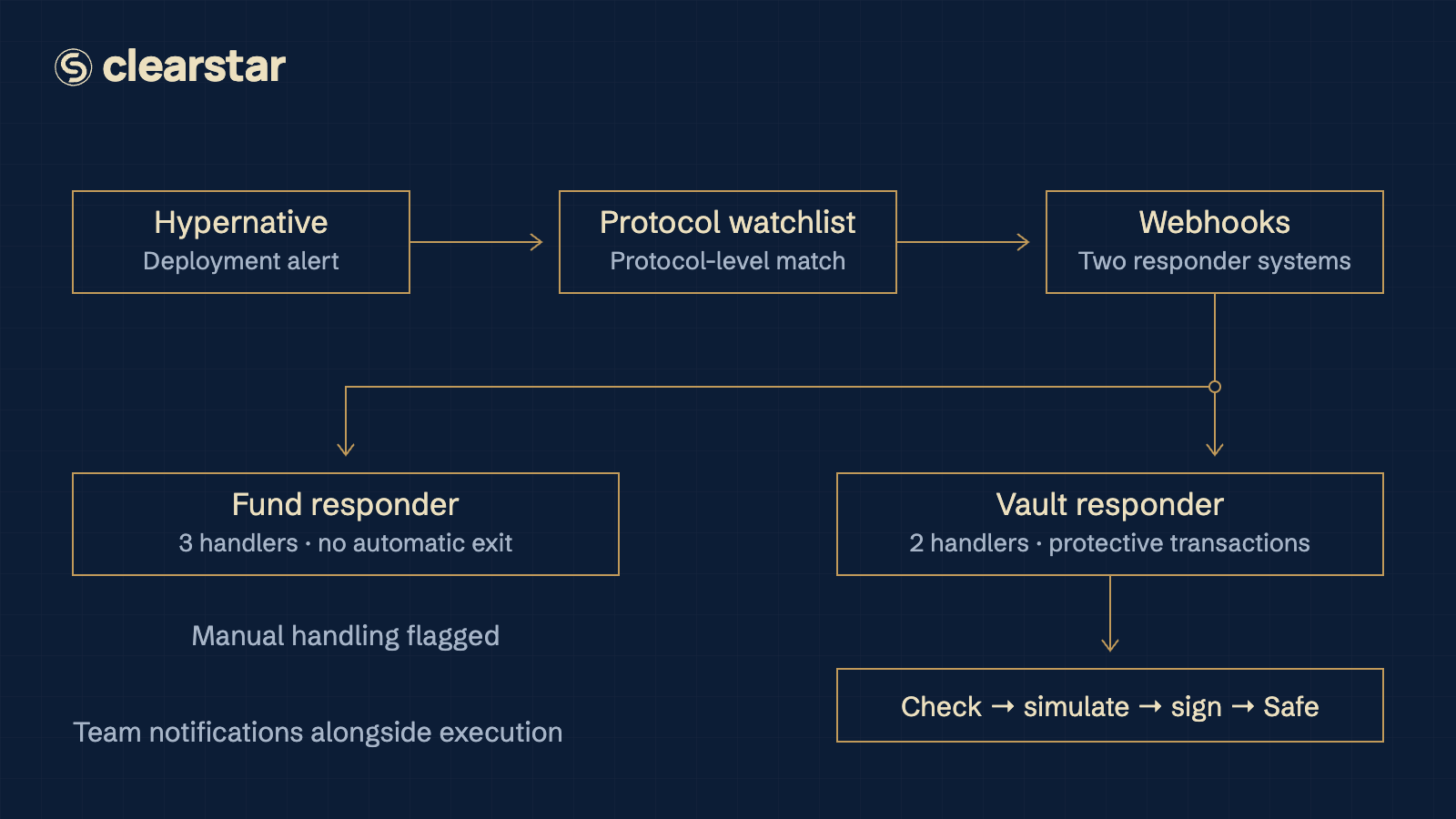
The alert matched a protocol-level entry in our watchlist. That configuration routes relevant alerts to the mapped response handlers. Coverage was therefore based on the protocol relationship, rather than requiring the alert to name one of our vault addresses.
How the warning reached our systems
Hypernative delivered webhooks to separate Clearstar fund and vault responders. Each request passed through an API Gateway to a Lambda handler. The intake checked a duplicate-message key, handed the work to an asynchronous invocation and acknowledged the request. Protective execution then continued independently of the webhook acknowledgement.
The vault responder received the first delivery 13.7 seconds after the flagged block; the fund responder received it at 14 seconds. The two systems ran in separate AWS regions. All five mapped handlers ran: two for the curated vaults and three for the fund. The fund handlers found nothing they could exit automatically and flagged directly held positions for manual handling. The withdrawals discussed below came from the curated vaults.
The team was notified alongside the automated execution. The first Action Required message reached the team channel at 17.4 seconds and woke a team member at 02:35 CET. Hypernative's own alert chat provided a separate route for the warning to reach us.
AI triage for an overnight response
Hypernative also provides automated AI triage reports to help responders understand the activity behind an alert. In this event, the team was woken at 02:35 CET. Having a structured technical assessment to work from was crucial to getting oriented quickly: what was deployed, which contracts it referenced and which behaviours needed investigation.
The Hypernative AI triage report for this deployment links the deployment transaction, identifies the contract and deployer, and presents decompiled code excerpts with explanations of the relevant call paths. It highlights an owner-gated flash-loan entry point, calls to the target contract's available and take functions, and a token-sweeping path. Its headline verdict is Inconclusive, with medium confidence. The report distinguishes inferred capabilities from observed execution, giving the team concrete call paths to investigate.
That context gives an overnight responder concrete leads to check rather than a transaction hash alone. For Clearstar, the operational value is a faster initial understanding while the defensive response runs. We then assess the flagged behaviour in context and decide whether to restore exposure. Hypernative's automated triage and our subsequent review are separate assessments; the decision to re-enter remained with our team.
From signal to confirmed withdrawal
The affected positions were USDC loans in two lending markets, held through two of our vaults. For the execution sequence below, we refer to them as Vault A and Vault B, and the markets as Market A and Market B. Withdrawing returned available USDC from those markets to the vaults.
Every response duration below starts at the timestamp of the block containing the flagged deployment. Durations do not start at the moment Hypernative's webhook reached us.
| Time from deployment | What happened |
|---|---|
| 13.7 seconds | Hypernative's alert reached our vault handler. |
| 17.4 seconds | The first Action Required message reached our team channel. |
| 18.1 seconds | Our system broadcast the first withdrawal transaction. |
| 36 seconds | Vault A's withdrawal of 5.8M USDC confirmed. |
| 48 seconds | The reallocator, our automated allocation bot, was paused. |
| 60 seconds | Vault B's allocation caps on both affected markets were set to zero. |
| 72 seconds | Vault B withdrew a further 1.7M USDC. |
Our handler's own work took 1.9 seconds, covering the hand-off, vault reads, signing and sending. Starting the execution environment added 2.5 seconds. After broadcast, block inclusion took 17.9 seconds: the next slot did not include the transaction, and it confirmed in the following one.
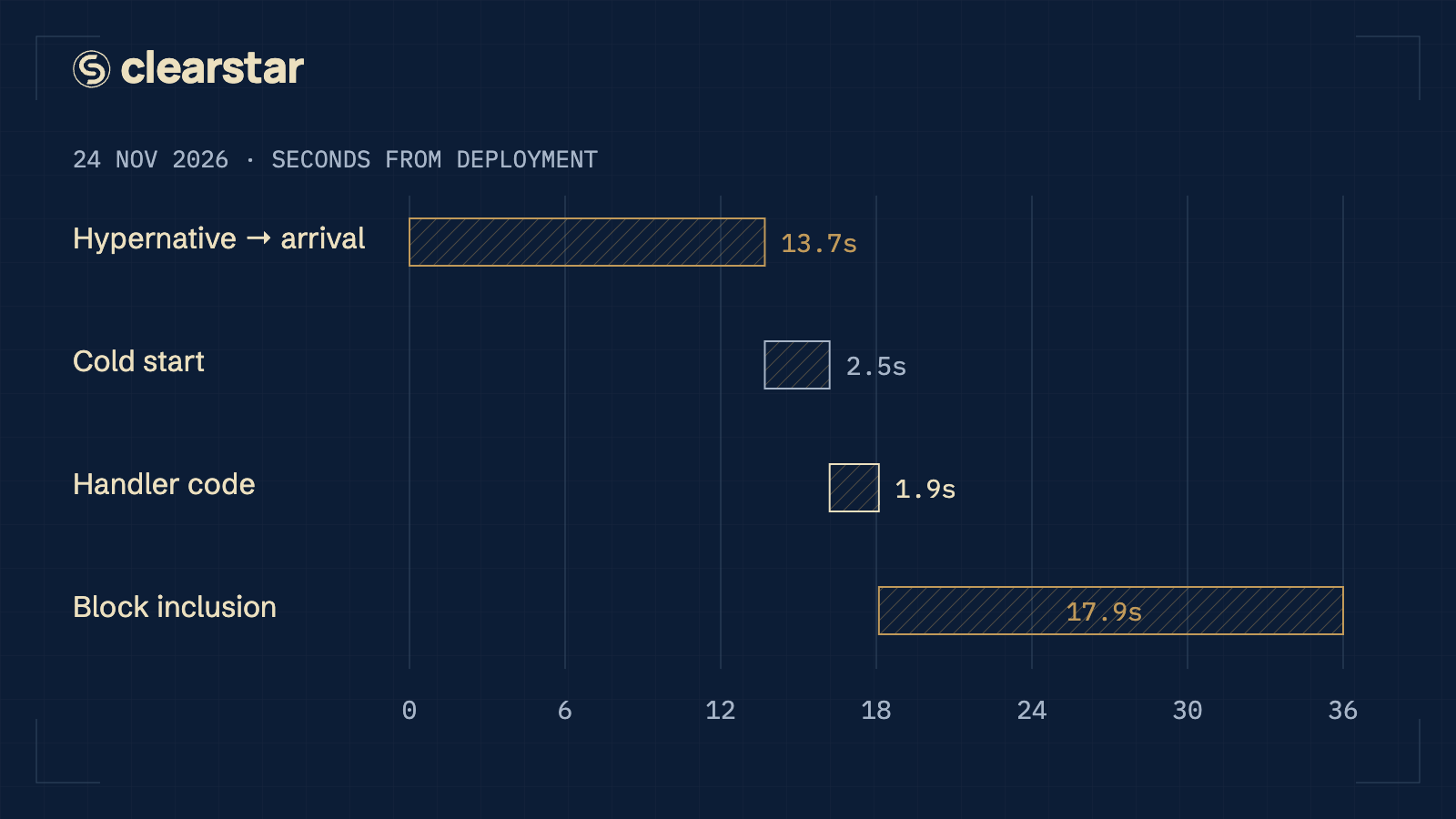
The first 13.7 seconds combine block propagation, detection and delivery. Our logs cannot separate those components because they do not retain Hypernative's send time and the full request-arrival record. The near-simultaneous deliveries to two regions narrow the possibilities, but do not establish a detection-only latency.
The execution path and its authority
The vault handler checked its sentinel authority, simulated the withdrawal, signed through cloud key management and relayed the transaction through its dedicated Safe. These were the first transactions for that signer and Safe. The complete path succeeded on its first live invocation.
Vault A’s initial withdrawal returned 4.8M USDC from Market A and 1M USDC from Market B. It then paused the reallocator by raising the allocation Safe's signing threshold from one owner to two. That prevented the usual automated process from immediately reinvesting withdrawn funds. Vault A's market caps stayed open by policy.
Vault B followed a different sequence: reduce its caps on both affected markets to zero, then withdraw its 1.7M USDC lending position in Market A. The original incident report recorded cap increases as timelocked. Those controls describe the defensive configuration during the initial response; they should not be read as the vault's permanent allocation state.
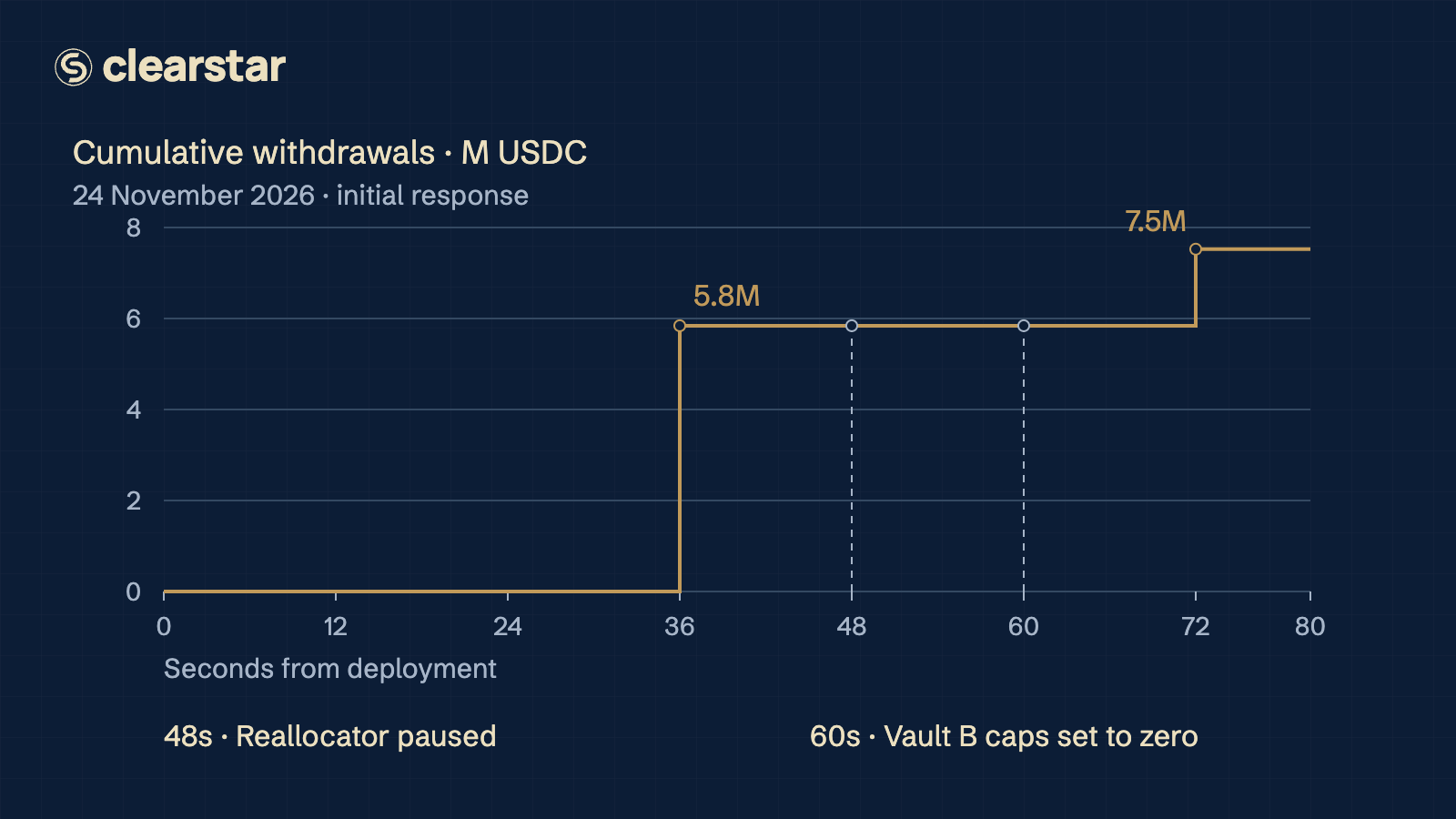
The four protective transactions confirmed in successive blocks. Cumulative withdrawals increased at 36 and 72 seconds; the intervening confirmations applied the allocator pause and Vault B cap changes. Completion of the control sequence did not mean every position had exited. The 84% withdrawal figure refers only to curated USDC exposure in the two affected markets, excluding the fund's direct holdings.
The limit was liquidity
Automation could withdraw only the USDC available in the lending markets. The initial response exited the curated exposure in Market A, while 1.4M USDC remained in Market B behind near-total utilisation. The withdrawal from Market B itself pushed that market to effectively full utilisation.
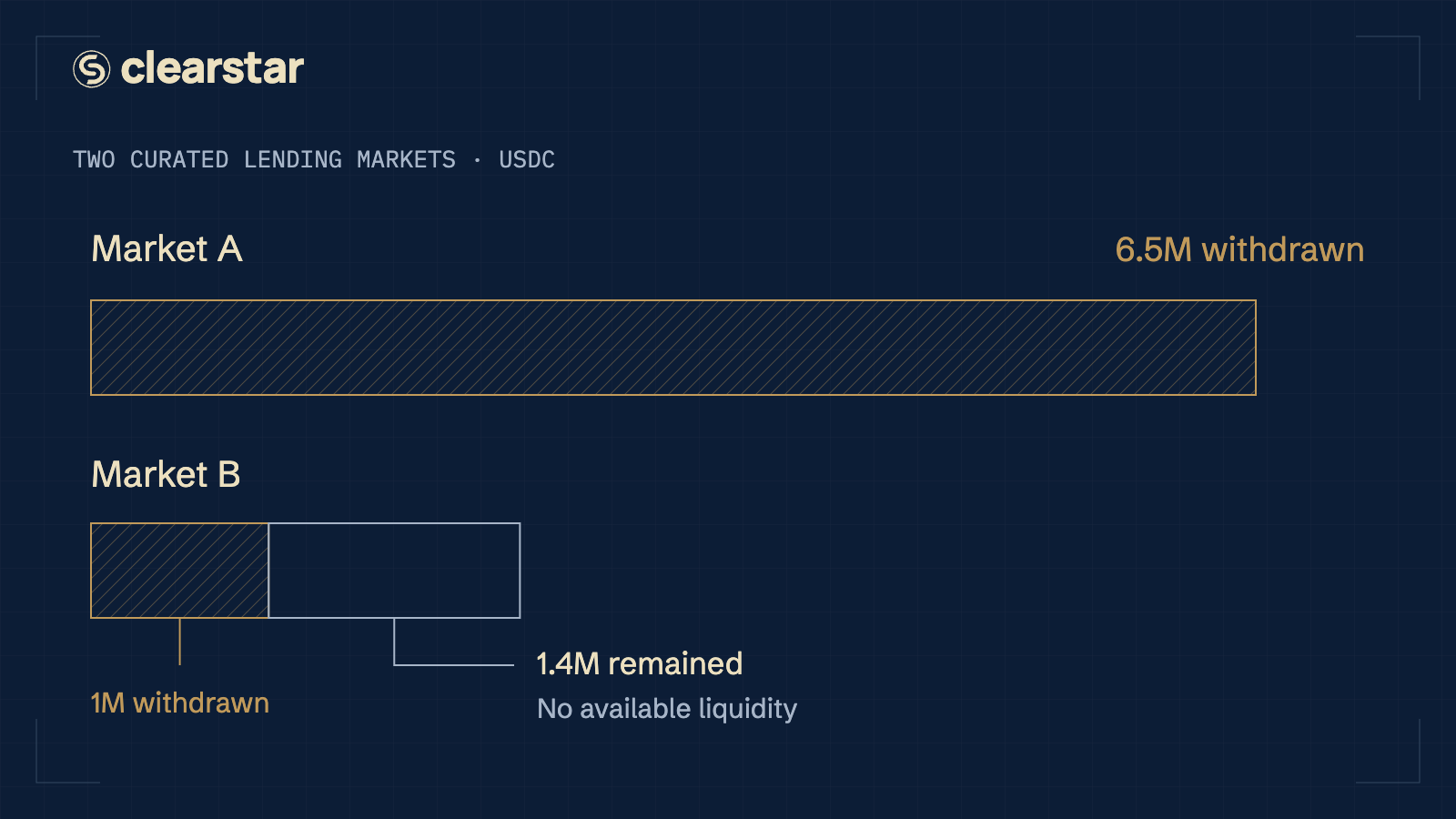
At 4 minutes 48 seconds after deployment, another curator supplied approximately 1M USDC, leaving 1M available to withdraw. That liquidity remained available for about five hours. Our system had no automatic retry for the partial withdrawal, and no manual retry occurred during that window.
This distinguishes transaction success from completion of the intended risk reduction. The initial withdrawal succeeded, but the response did not revisit the remaining position when liquidity returned. A partial exit needs continued tracking of both the outstanding exposure and newly available liquidity.
The report also observed other market participants supplying capital after our exit. That activity illustrates how liquidity conditions can change after an alert. It does not establish whether those participants received the same warning or how they assessed it.
What our contract review established
Our review identified a flash-loan arbitrage bot. We analysed the deployed bytecode because the contract's source was not published. Its functions described a route that borrows funds, buys tokens through an auction contract, sells through a Curve pool and other routes, then repays the loan and retains the margin. The monitored pool was part of that trading route.
The analysis found no minting exploit, oracle manipulation or use of other users' approvals. The deployer's privacy-pool funding and multiple contract deployments nevertheless warranted prompt investigation. Clearstar's response policy favours reducing exposure while we review such signals, even when the likelihood of exploitation may be low.
At the incident report's 08:40 UTC snapshot, neither copy of the flagged contract had been called, funded or used to move tokens. The arbitrage classification describes the code's purpose; it does not claim an observed or profitable trade. The review recorded medium-high confidence, while the deployer's identity and intent remained unknown.
Re-entry followed our review
After assessing the contract behaviour and available evidence, Clearstar deliberately re-entered both affected vaults. These were decisions by our team following the investigation, rather than automatic reversals of the alert response.
The original report captured Vault A's reviewed re-entry and still showed Vault B's affected exposure closed at its data cutoff. Vault B's re-entry happened after the report was run. This article includes that subsequent operational update, so the report's Vault B snapshot should not be mistaken for the final outcome.
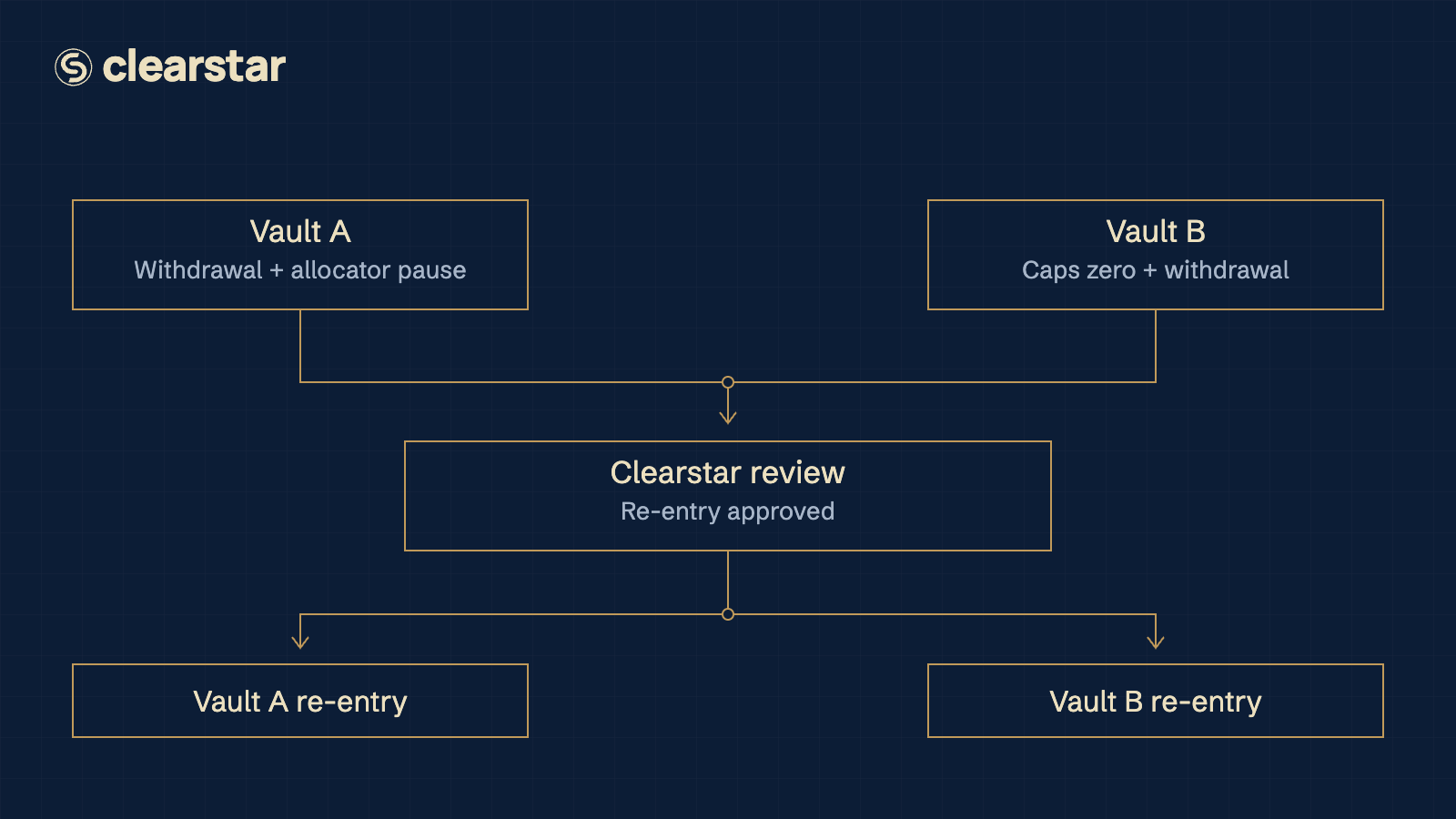
The distinction between automatic risk reduction and reviewed re-entry is central to this response. The initial warning triggered the preconfigured defensive actions; the decision to restore exposure depended on our assessment of the contract and the absence of an exploit.
What the live run exposed
Duplicate records must resolve to one event
Hypernative produced two alert records for the same deployment transaction. Their asset lists differed in order, so our duplicate check, based on the full message body, treated them as different alerts. Both passed and started parallel vault responses.
The second run sent the same Safe transaction again. The original withdrawal confirmed; the duplicate never mined. After waiting for a timeout, the second run generated misleading messages saying nothing had been withdrawn and that positions had not been exited. Those messages contradicted the successful first transaction and added noise while the team was investigating.
The engineering implication is specific: identify an event by stable fields such as transaction and risk type, coordinate concurrent work on the same vault, and reconcile confirmed state before sending a failure message. Successful webhook delivery and successful risk reduction are separate states that the reporting should preserve.
Sequencing affects the protection window
Each action waited for the previous transaction to confirm. This extended the first withdrawal at 36 seconds into the 72-second sequence. It also left a 12-second interval between the Vault A withdrawal and the allocator pause, during which reinvestment was possible. No reinvestment occurred in that interval.
The review therefore identified transaction ordering and confirmation dependencies as areas for improvement, alongside retries for partial exits. Any revised sequence must preserve authority checks and transaction dependencies while reducing unnecessary waits.
Latency needs to be observable end to end
Cold starts contributed 2.5 seconds, while the handler's own work took 1.9 seconds. Recording the alert identifier, provider timestamps, request arrival and each transaction state would make future latency analysis more precise. The observed 36-second first withdrawal includes both Clearstar's work and time outside the handler, particularly block inclusion.
These are findings from the live run. They do not imply that every identified improvement has already been deployed. The core connection worked: Hypernative delivered an early signal, Clearstar executed withdrawals and controls, and our team investigated before deliberately restoring exposure to both vaults.
Evidence and scope
The incident review used Hypernative API records, AWS CloudWatch logs and Ethereum mainnet events. It reconstructed positions from 61,204 Morpho events across the two markets and checked the resulting balances onchain. Contract analysis used deployed bytecode and public function-signature data. Hypernative’s automated AI triage report supplied a separate, structured assessment of the flagged deployment; its verdict and confidence are distinguished from Clearstar’s subsequent review.
The numerical incident snapshot is 08:40 UTC on 24 November 2026. The later Vault B re-entry is an additional operational update from Clearstar's team. Notification wording in the original review was reconstructed from deployed code and log times, without independently reading Telegram message history.
The 36-second and 72-second results describe this event. Available liquidity, block inclusion and the nature of a future threat can change the outcome. No exploit or loss was observed. The withdrawals demonstrate our precautionary response to an early warning; they do not quantify losses avoided.