
sUSN — Noon (Ethereum) — June 2026 (archived)
sUSN is an ERC-4626 savings vault over USN, an off-chain-collateralised synthetic dollar earning a diversified delta-neutral and RWA carry. The peg has held within 43bps over 90 days and the yield is fully organic with zero token emissions, but backing is structurally off-chain behind an offshore wrapper attested only by a live ~1% proof-of-reserves buffer, the binding-under-stress exit is a 7-day queue settling into a thin DEX (43% slippage at $500k), and the redeem admin is a single EOA held outside the 48-hour timelock.
Strengths
- Tight peg and sustained organic yield: USN held the dollar within 43bps over 90 days, and sUSN accrues real strategy carry with zero incentive dependence — 456 rebases over 575 days, current realised APY ~7–8%.
- Mature, multi-firm audit cadence over a faithful ERC-4626 core: four reputable firms across six engagements over ~21 months, bespoke modifications separately audited, and bounded mint/redeem in the deployed configuration.
- Named, pedigree-verified leadership and a disclosed operating entity: a named CEO/co-founder with an independently verifiable TradFi-and-crypto background, a named community lead, and a disclosed operating entity (DCLF Labs, BVI).
- Diversified, named counterparty rails attested in real time: no single on-chain venue exceeds 50% of TVL, and reserves are attested live by an independent third party (101.06% collateralisation) across named custodians including a US FINRA/SIPC broker.
Risks & Constraints
- Exit illiquidity at size: the binding exit path is materially impaired — USN→USDC slips 43.4% at $500k and the only permissionless on-chain cash-out is a thin DEX, while the mandatory 7-day withdrawal queue settles into USN and is only 0.46% pre-funded.
- Single-key redeem admin: the redeemer's admin role is held solely by an EOA outside the 48-hour timelock, able to re-grant the burn role and raise the per-block redeem cap with no on-chain bound.
- Off-chain backing opacity behind an offshore wrapper: USN backing is structurally off-chain (~$98M swept to custodians), the operating entity is an offshore BVI wrapper with off-chain/contractual recourse only, and reserves are attested off-chain with only a ~1% buffer (101.06% PoR).
- Oracle weakness: a custom price oracle is stale and EOA-owned with no deviation bounds or fallback on its external consumers — isolated from the vault's price-per-share, but the weakest control surface in the General track.
Verdict & conditions
Tier 3 — Adequate. The APB composite is 2.72. The Protocol track (3.18) exceeds 3.0, triggering a track penalty that scales its weight and lifts the composite into the upper Tier-3 band. No failing grade remains on any track, so the F-gate passes.
The instrument is sUSN, an ERC-4626 savings vault over USN — an off-chain-collateralised synthetic dollar. It is live at ~$30.9M of TVL, ~16.6 months in production, with a tight peg and fully organic carry.
Conditions to revisit:
- Exit capacity is the binding constraint: a liquidity-feasible exit sits well inside USN→USDC depth, below the ~$500k / 43% slippage point.
- Treat the redeemer as single-key-controlled until its admin role migrates from the EOA to the 3-of-6 Safe behind the 48-hour timelock.
- Monitor the live proof-of-reserves feed for any reading below 100% — the buffer is only ~1%.
- Migrate the Ethereum cross-chain delegate off its live single EOA and watch for the addition of a mint-side rate limiter on the bridge paths.
Overview
| Position | Hold sUSN — an ERC-4626 yield-vault claim on USN, an off-chain-collateralised synthetic dollar |
| Mechanism | Deposit USN into the sUSN ERC-4626 vault; net strategy carry re-enters on-chain via a daily rebase that raises price-per-share (no new shares minted) |
| Backing | USN minted against whitelisted USDC/USDT, then swept off-chain to custodians and deployed into a diversified delta-neutral and RWA carry book; backing is structurally off-chain |
| Yield | 80% of net strategy carry — CeFi funding-rate (basis) arbitrage + RWA carry (T-bills, CLO, private credit) + on-chain lending; ~7–8% current realised APY, organic with zero token subsidy |
| Exit | Mandatory permissionless 7-day withdrawal queue settling into USN; the only permissionless on-chain cash-out for USN is a thin DEX |
| Chains | Ethereum (primary — 78.6% of supply + 100% of the yield vault); Base (19.0%) and HyperEVM (2.4%) via a third-party bridge |
Key metrics
| Metric | Value | Date (UTC) | Source |
|---|---|---|---|
sUSN TVL (totalAssets) | 30,875,494.8 USN (~$30.9M) | 2026-06-24 | On-chain |
| sUSN total supply | 25,705,678.3 sUSN | 2026-06-24 | On-chain |
| sUSN exchange rate | 1.2011 USN/sUSN | 2026-06-24 | On-chain (convertToAssets) |
| USN total supply | 33,140,011.7 USN | 2026-06-24 | On-chain |
| Realised rebase APY (30d / 90d) | 8.57% / 7.20% | 2026-06-24 | On-chain (rebase logs) |
| Lifetime USN rebased | 2,775,092 USN over 575d (456 rebases) | 2026-06-24 | On-chain (rebase logs) |
| Live proof-of-reserves collateralisation | 101.06% (reserves $37.49M / supply $37.09M) | 2026-06-24 | Accountable (independent live attestation) |
| Reserve custodian split | Fasanara 64.6% / Alpaca 24.0% / Safe 10.5% / ForDefi 1.0% / Ceffu ~0% | 2026-06-24 | Accountable |
| USN→USDC slippage | 0.19% @$100k → 43.4% @$500k → 71.7% @$1M | 2026-06-24 | Odos slippage curve |
| Withdrawal-queue pre-funding | 142,621 USN = 0.46% of TVL | 2026-06-24 | On-chain |
| sUSN withdrawal cooldown | 7.0 days | 2026-06-24 | On-chain |
| Bridged supply share | 21.4% (Base 19.0% / HyperEVM 2.4%) | 2026-06-24 | On-chain (per chain) |
| USN/USD peg (90d) | min $0.9968 / max $1.0043; max deviation 43bps; vol 0.034%/d | 2026-06-24 | CoinGecko |
| Time live | 16.6 months (since 2025-02-03) | 2026-06-24 | DeFiLlama |
| Max TVL drawdown | 37.5% (peak-to-trough, orderly outflow) | 2026-06-24 | DeFiLlama |
| Audit status | 4 firms / 6 engagements, Sep 2024 – Mar 2026 | 2026-06-24 | Audit reports |
Economic model & what you are holding
sUSN is an ERC-4626 savings vault over USN, an off-chain-collateralised synthetic dollar. The real return comes from a diversified delta-neutral / carry book run off-chain: CeFi funding-rate (basis) arbitrage settled through off-exchange-settlement (OES) custodians, plus RWA carry (tokenised T-bills via a regulated broker, a Janus Henderson AAA CLO ETF, and a Fasanara private-credit fund), plus on-chain DeFi lending and PT looping. Depositor collateral (USDC/USDT) is swept on-chain from the minter to a custodial Safe, then out to custodians and exchanges — roughly $98M cumulative swept off-chain, with only ~$310k residual on-chain. The dominant named custodian is Ceffu (an institutional OES provider). Yield re-enters on-chain via a rebase that raises sUSN's price-per-share, minting no new shares.
| Token | Role / seniority | Yield basis | Collateral / mint | Redemption | Character |
|---|---|---|---|---|---|
| USN | Synthetic-dollar liability (base unit) | None directly (transfers value to sUSN via rebase) | Minted against whitelisted USDC/USDT, oracle-banded (±0.5%, 48h staleness), 10M/block cap, signature-gated | Native redeem via burn role + a signed off-chain order, or open-market DEX | Off-chain-backed stablecoin; backing structurally off-chain |
| sUSN | Yield-bearing claim on USN (single tranche) | 80% of net strategy carry via daily rebase; rate 1.2011 USN/sUSN (~20% lifetime, ~7–8% current) | Deposit USN into the ERC-4626 vault | Permissionless 7-day withdrawal queue into USN, or DEX | Single-tranche; bears full backing and liquidity risk |
| NOON | Governance token (1B fixed supply) | Indirect; not in the sUSN yield path | n/a | n/a | Separate governance layer; 0% of sUSN yield depends on it |
What the holder is getting into:
- A claim on an off-chain-backed synthetic dollar whose backing is verifiable only via an off-chain proof-of-reserves feed (101.06%, ~1% buffer) — not an on-chain over-collateralised position.
- Yield that is organic but cyclical (funding-rate / basis / RWA carry), already compressed from ~20% lifetime to ~7–8% current — durable in concept, market-dependent in practice.
- An exit that is slow and/or costly: a mandatory 7-day queue into USN, whose only permissionless cash-out is a thin DEX (43% slippage at $500k). This differs sharply from a vanilla collateralised position with instant on-chain redemption.
- Counterparty/credit exposure that runs to off-chain custodians and a private-credit fund, mitigated by segregated OES custody, a live PoR feed and a $1.85M insurance fund, but with undisclosed per-strategy allocations.
Top risks, ranked
| # | Risk | Mechanism | Severity |
|---|---|---|---|
| 1 | Exit illiquidity at size | The 7-day queue settles into USN; the only permissionless cash-out is a thin DEX (43% slip @$500k); a ~$3.09M reference exit is far past the 6% open-market bar | High |
| 2 | Single-EOA redeem admin | The redeemer's admin role sits outside the 48h timelock on a single EOA that can re-grant the burn role and raise the 10M/block redeem cap with no on-chain bound | High |
| 3 | Off-chain backing opacity | USN backing is ~100% off-chain behind an offshore BVI wrapper with off-chain recourse only; reserves attested off-chain with a ~1% buffer | High |
| 4 | Oracle weakness | A custom PT price oracle is stale and EOA-owned with no deviation bounds or fallback on external consumers (isolated from vault price-per-share) | High |
| 5 | Bridge residuals | ~21% of supply is bridged; no mint-side rate limiter on either path, an instant single-EOA delegate on the 100%-TVL chain, and a re-pointable default module; realisable blast escrow-bounded ~$12.3M (native vault not drainable) | Medium |
| 6 | Post-audit drift | The deployed vault implementation post-dates the only audit covering it; the deployed-bytecode-to-audited-commit match is not publicly diffable | Medium |
| 7 | Yield compression | Realised carry fell from ~20% to ~7–8%; organic but funding/basis/RWA-dependent | Medium |
| 8 | Holder concentration | The largest direct EOA holds ~41% of real float (~$3.0M), exceeding on-chain exit depth | Low |
General DD
General composite: 2.93.
| # | Area | Grade | Observation | Why not adjacent |
|---|---|---|---|---|
| 1 | Governance & access control | C | Multisig custody (3-of-6 / 3-of-4) with the core ProxyAdmins behind a 48h timelock | Not B: direct role admin is held by the Safe rather than the timelock, and RBAC discovery is partial |
| 2 | Smart-contract security | B | Four reputable firms over a ~21-month cadence, all in-scope contracts verified, no fork or exploit | Capped at B: no public proxy-upgrade check, no bug bounty, and incomplete RBAC discovery |
| 3 | Oracle security | D | A custom RateProvider and PT price oracle exist | Not C: a verified weak surface — stale read (updatedAt=0), EOA-owned, no deviation bounds or fallback evidence on external consumers |
| 4 | On-chain financial audit | C | TVL reconciles on-chain (~$30.6M) | Not B: an issued-supply reporting discrepancy, 100% single-vault concentration, failed stress tests, and no on-chain PoR |
| 5 | Team reputation & transparency | B | Named CEO/co-founder (UPenn/Wharton; McKinsey/Goldman/Revverbank/Dexterity/DCL Markets — pedigree independently verifiable), a named community lead, and a disclosed operating entity (DCLF Labs, BVI) | Not A: only a partial team is named (no CTO/engineering leadership first-party) and there is no multi-cycle, publicly-attested protocol track record |
| 6 | Economic design | C | A real 1.20 exchange rate with no emission-driven yield | Not B: opaque yield source, off-chain-verified backing, extreme single-vault concentration, and failed stress tests |
| (7) | Bridge security | C | ~21% of supply is bridged; live cross-chain mint routes mainly via a third-party m-of-n bridge, the value-bearing legacy paths are genuine 2-of-2 verifications, config is m-of-n Safe + 24–48h timelock, and the worst-case blast is escrow-bounded (~$12.3M; the 78.6% native vault is a lock/unlock adapter, not drainable by a forged message) | Not B: no mint-side rate limiter on either path, an instant single-EOA delegate on the 100%-TVL chain, a cosmetic outer aggregation whose worst registered lane collapses to 3-of-5, and a re-pointable default module. Not D: m-of-n mint + 2-of-2 value paths + multisig/timelock config + bounded blast |
Oracle security is the only General-track D.
Asset DD
Asset composite: 2.94. A solid yield-bearing synthetic dollar undermined by exit illiquidity (Asset 3, D) and off-chain backing / issuer opacity.
| # | Area | Grade | Observation | Why not adjacent |
|---|---|---|---|---|
| 1 | Asset mechanism & design | C | USN is an off-chain-collateralised synthetic dollar (~$98M swept off-chain, dominant custodian Ceffu, named); mint is bounded, oracle-banded and capped; price-per-share 1.2011 | Not B: off-chain custody is still material, backing via off-chain PoR only. Not D: no red flag — a named regulated OES custodian and bounded mint |
| 2 | Ownership & supply distribution | C | With infrastructure netted out, real float is ~6.08M; the largest non-infrastructure EOA holds ~41% of float (~$3.0M); no emissions | Not B: 41% of float far exceeds the ~20% bar. Not D: the dominant on-chain holders are decentralised aggregators of dispersed users, not a single whale |
| 3 | Liquidity & market depth | D | A ~10%-of-TVL reference exit is ~$3.09M; USN→USDC slips 43.4% at $500k (live); native redeem is gated by a burn role + a signed off-chain order; the 7-day queue settles into USN and is 0.46% pre-funded | Not C: open-market slip of 43% far exceeds the 3% bar and there is no permissionless on-chain settlement. Not F: a working, uncapped 7-day redeem into peg-holding USN is a viable small-size exit |
| 4 | Volatility & price behaviour | A | USN/USD over 90d: max deviation 43bps, daily vol 0.034% (~0.7% annualised), no depeg; sUSN drifts up monotonically (1.2011) | Not B: 43bps is inside the <50bps A bound — intraday noise, no recovery lag, negligible crypto-beta |
| 5 | Smart-contract implementation | C | All in-scope contracts verified; the deployed vault implementation (set 2025-07-09) post-dates the only audit covering it by ~3.5mo, with the bytecode match not diffable; no bug bounty; hooks bounded (10M/block, 2% band, whitelist, signed orders) | Not B: post-audit drift hard-caps at C, and there is no bug bounty. Not D: no unremediated HIGH (the vault audit was 0C/0H, fully solved) and hooks are not unmitigated |
| 6 | Incentives & sustainability | C | Incentive dependence is 0% (USN rebase, not the governance token); realised carry compressed from ~20% to ~7–8% (last-30 8.57% / last-90 7.20%); 456 rebases over 575d, no cliff | Not B: carry is funding/basis/RWA-dependent and visibly compressed. Not D: genuine carry, continuous for 19 months, no imminent cliff or inversion |
| 7 | Dependencies & external risks | C | Off-chain CeFi OES (Ceffu, named) plus a 3-month private-credit lock; diversified across arb / T-bills / CLO / private credit / DeFi; no single on-chain venue >50%; intermediary contracts unverified | Not B: real off-chain counterparty credit and unverified intermediaries. Not D: no single anonymous limb >50% — exposure fans across rails and the dominant one is a named OES custodian with segregated custody, PoR and an insurance fund |
| 8 | Regulatory & issuer risk | C | Operating entity DCLF Labs (BVI) disclosed in the issuer launch filing and the code-owning GitHub org; no MiCA/VARA authorisation; live PoR 101.06%, named custodians including a US FINRA/SIPC broker | Not B: no regulated issuer or clearly-enforceable wrapper — an offshore BVI shell. Not D: the entity is disclosed first-party and recourse is backed by live attested reserves |
Asset 3 (D). The binding-under-stress exit is materially impaired. The native USN redeem leg is gated by a burn role plus a signed off-chain order whose collateral amount is set by the protocol signer (no oracle band) — an off-chain / discretionary gate, not a daily-liquid on-chain settlement leg. The only permissionless cash-out is the thin USN→USDC DEX (43.4% slip at $500k); a ~$3.09M reference exit is roughly 6× past the open-market bar. The permissionless, uncapped 7-day withdrawal queue settles into USN and is only 0.46% pre-funded (~$142,621). It is D, not F: a working, peg-holding, small-size exit remains.
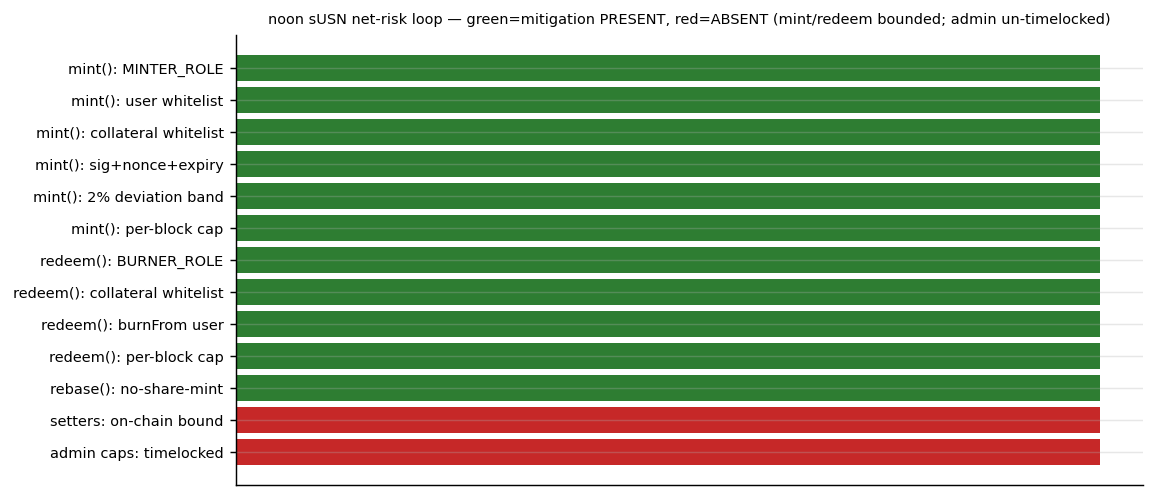
Asset 7 net-risk mitigations (the basis for the C rather than a D): the chart below shows the candidate mitigations checked present/absent on the off-chain counterparty surface.
Protocol DD
Protocol composite: 3.18 (pulled by the Protocol 8 D). A faithful ERC-4626 vault with sound mechanics and audited modifications, but a 7-day un-pre-funded exit queue and a single-EOA redeem admin.
| # | Area | Grade | Observation | Why not adjacent |
|---|---|---|---|---|
| 1 | Protocol design & mechanics | C | Standard OZ ERC-4626, yield via rebase (no share mint, no loss-of-funds mode in source); public withdraw forces a 7-day queue, un-pre-funded (0.46% TVL), with an admin-extendable period and no cap or timelock | Not B: exit is not prompt or unconditional. Not D: no capital trap — a bounded time-delay that cannot strand principal, with sound price-per-share math |
| 2 | Proven model & lineage | C | A bespoke withdrawal handler plus bridge OFT adapters, separately audited; ~16.6mo live; $30.9M TVL; peers include Ethena sUSDe / Elixir deUSD / Resolv stUSR | Not B: the deployed implementation (2025-07-09) post-dates the latest diffable audit covering it, match not diffable → max C. Not D: 16.6mo live, modifications genuinely in-scope, faithful OZ core |
| 3 | Fee structure & economic model | C | Rebase only transfers USN in (raises PPS); no rebase limit / fee setter / skim on-chain → no expropriation; the 80/10/10 split and cadence are off-chain / admin-discretionary; self-sustaining from carry (0% token subsidy) | Not B: split and cadence are off-chain and discretionary, competitiveness uncertain as yield compresses. Not D: no unbounded on-chain fee setter; rebase can only add assets |
| 4 | Operational history & stress | C | 16.6mo live; a 37.5% drawdown absorbed (orderly outflow) with no incident, exploit or bad debt; clean admin-revocation hygiene | Not B: no protocol-specific stress event survived — hard cap applies. Not D: no incident with user losses, no botched-upgrade or repeated pause |
| 5 | Liquidation & risk management | C | sUSN is non-leveraged ERC-4626; the risk surface is the permissionless, uncapped 7-day queue (0.46% pre-funded) settling into USN; no on-chain liquidation or insurance at the vault layer | Not B: the uncapped queue is not battle-tested and settles into a thin-liquidity asset. Not D: no admin-reachable drain, no bad-debt event |
| 6 | Dependency chain | C | Two single points of failure probed: the PT oracle (stale, EOA-owned) is read-only by external lenders and does not feed vault PPS; the custodian rail is dominated by a named OES provider and fans across intermediaries; full flow traced | Not B: chain depth plus off-chain custody and a stale EOA-owned oracle exceed the B bar. Not D: no critical SPOF without fallback cascading to TVL — the oracle is isolated and custody is diversified with PoR and insurance |
| 7 | Integration & composability | C | Open standards (ERC-4626 / ERC-20 / bridge OFT) with broad integration, but sUSN is Morpho collateral and underlies a Spectra PT → bounded recursive looping; the Morpho oracle is immutable; the Spectra oracle is EOA-owned but isolated from PPS; reentrancy guard present | Not B: any recursion forbids A/B → max C. Not D: recursion is bounded by isolated-market LLTV, the oracle is immutable/standard, and the Spectra leg is isolated from the vault |
| 8 | Governance attack surface | D | Upgrade authority is sound — a 48h timelock owns the ProxyAdmins — but the redeemer's admin role is held solely by an EOA (also holding the live burn role), able to re-grant the burn role and raise the 10M/block redeem cap (no bound, no timelock) | Not C: a critical operational admin sits on a single EOA outside any timelock — the ladder's D condition. Not F: no demonstrated drain; redeem is bounded and exploitation needs multi-step reconfiguration |
Protocol 8 (D). Upgrade authority is sound — a 48h timelock controller owns the ProxyAdmins. The D rests on operational role custody: the redeemer's admin role is held solely by an EOA, outside the timelock, able to re-grant the burn role and raise the per-block redeem cap (10M USN/block, no on-chain upper bound). An earlier admin EOA was genuinely revoked from all three handlers (the minter and withdrawal handlers are now Safe-3-of-6-only); the residual is the single-EOA redeem admin. It clears to C the moment it migrates to the Safe / timelock.
Blockchain DD
Blockchain composite: 1.25. The primary chain is Ethereum L1 (~79% of supply + 100% of the yield vault); chain risk is not material except the bridge surface (Blockchain 7, C).
| # | Area | Grade | Observation | Why not adjacent |
|---|---|---|---|---|
| 1 | Decentralisation & validator set | A | Ethereum L1 (~79% of supply + 100% of the vault), ~1M+ validators, broad geographic diversity; Base (19%) is OP-Stack with an escape hatch; HyperEVM (2.4%) is a smaller validator set | Not B: the primary chain is the A baseline; the centralised-sequencer concern attaches only to the 19% Base slice |
| 2 | Consensus & security model | A | Ethereum Gasper PoS, ~$100B+ staked, finality ~2 epochs; Base inherits L1 via live fault proofs; HyperEVM HyperBFT is a 2.4% slice | Not B: the dominant chain has the highest economic-security budget |
| 3 | Client diversity | A | Ethereum has multiple independent clients with no supermajority; Base/HyperEVM are single-client but rest on L1 + proofs or their own BFT | Not B: the ~79%-of-position chain is best-in-class; single-client secondaries graded in context |
| 4 | Uptime & reliability | A | Ethereum has zero full halts in 10+ years (~12s slots); Base no full halts; HyperEVM young with no material halt observed | Not B: the dominant chain has flawless uptime |
| 5 | Maturity & ecosystem | A | Ethereum ~$38.2B TVL, deepest ecosystem, 10+ years; Base and HyperEVM are B/C peers but secondary | Not B: Ethereum defines the top of the peer set and is the predominant deployment |
| 6 | Validator behaviour | A | Ethereum PBS via MEV-Boost plus an inclusion-list roadmap, non-censoring relays, clean slashing | Not B: the dominant chain has the most-developed MEV stack; no censorship red flag on any in-scope chain |
| 7 | Bridge security & cross-chain | C | ~21.4% of supply is bridged via a third-party m-of-n bridge (Base 19.0% / HyperEVM 2.4%); live inbound mint binds mainly at m-of-n, the value-bearing legacy paths are genuine 2-of-2 verifications, config is m-of-n Safe + 48h/24h timelocks, and the blast is escrow-bounded ~$12.3M (the 78.6% native vault is a lock/unlock adapter, not drainable) | Not B: residuals — no mint-side rate limiter on either path, an instant single-EOA delegate on the 100%-TVL chain, a cosmetic outer aggregation / 3-of-5 collapsed lane, and a re-pointable default module. Not D: m-of-n mint + 2-of-2 value paths + multisig/timelock config + bounded blast |
| 8 | Regulatory & jurisdictional | A | Ethereum is credibly neutral with no chain-level action; Base carries Coinbase/US exposure (19% slice); HyperEVM is an offshore foundation | Not B: the predominant chain is the credibly-neutral A baseline; US exposure attaches only to the secondary Base slice |
Blockchain 7 (C). ~21.4% of sUSN supply lives off the native Ethereum vault (Base 19.0% / HyperEVM 2.4%); the live cross-chain mint routes mainly via a third-party m-of-n bridge, with no native/canonical escrow bridge. The Ethereum-origin inbound lane binds at 6-of-10 independent validators, but the outer 2-of-2 aggregation is cosmetic and the worst registered lane collapses to a 3-of-5 multisig; the default verification module is re-pointable by bridge-infrastructure owners with no observed timelock. The value-bearing legacy inbound-to-Ethereum paths are genuine 2-of-2 verifications, with total realistic blast on those paths ≈ $124k. There is no mint-side rate limiter on either path; the realistic over-mint blast is escrow-/backing-bounded at ~$12.3M — the Ethereum vault is a lock/unlock adapter, so a forged inbound packet unlocks from the on-chain escrow and reverts past it, leaving the 78.6% native vault not drainable. Config setters are m-of-n Safes (3-of-6 ETH / 3-of-5 Base/HyperEVM) and implementation upgrades are timelock-gated (48h ETH / 24h Base / 24h HyperEVM). Net: C, not B because of the residuals (no rate limiter, instant single-EOA delegate, 3-of-5 collapsed lane, re-pointable module); C, not D because of the m-of-n mint, 2-of-2 value paths, multisig/timelock config and bounded blast.
Strategy & counterparty exposure
The strategy is a diversified, multi-venue delta-neutral / carry book: CeFi funding-rate arbitrage (long spot / short perp, OES-settled) + RWA carry (T-bills, AAA CLO, private credit) + on-chain DeFi lending / PT looping. Funding dependence is on yield, not principal — a funding flip erodes APY, not backing. Most legs unwind T+0 to T+3; the private-credit leg is locked T+3 months and redemptions are committed T+5. No aggregate leverage ratio is disclosed.
Capital-flow map
| Hop | Destination | Type | Note |
|---|---|---|---|
| 1 | Minter | Handler | USDC/USDT in, USN out (bounded mint) |
| 2 | Custodial Safe | Gnosis Safe | On-chain → off-chain handoff; ~$98M cumulative swept (USDC ~$34.1M + USDT ~$63.7M); ~$310k residual on-chain |
| 3 | Sweep intermediaries | Unverified contracts | Fan out to multiple onward addresses (USDC ~$33.2M; USDT ~$46.7M across two rails) |
| 4 | Custodian (Ceffu OES) | CEX / OES custody | Named (Etherscan tag + Noon docs); ~$53.8M USDT; segregated / mirrored OES |
| 5 | sUSN vault | ERC-4626 | Rebase raises price-per-share (1.2011 USN/sUSN) |
| 6 | Redeemer | Handler | T+5 commitment; off-chain / discretionary gate |
Counterparty credit exposure
| Counterparty | Type | Exposure | Recoverability |
|---|---|---|---|
| Ceffu (institutional OES) | CEX / OES custody | Dominant USDT rail (~$53.8M held) | High — identifiable regulated custodian, segregated / mirrored custody, PoR + insurance fund; tail = custodian insolvency or operational failure |
| Fasanara (private credit) | Private-credit fund (~$6B AUM) | 64.6% of attested reserves; T+3-month lock | Recoverable at NAV after notice; illiquidity risk on a redemption run; per-strategy size undisclosed |
| Alpaca Securities | US T-bill broker (FINRA/SIPC) | 24.0% of attested reserves | High — T-bills + SIPC + Lloyd's excess insurance |
| Janus Henderson AAA CLO ETF | RWA (AAA CLO tranche) | Within reserves | High — exchange-traded, most-liquid public CLO |
| Off-exchange-settled CEXs | Funding-rate arb venues | Basis legs | Exchange default mitigated by OES; a funding flip erodes yield, not principal |
Net read:
- The dominant credit exposure is off-chain custody (Ceffu OES) plus private credit (Fasanara, 3-month lock) — the material monitored dependency.
- No single on-chain venue exceeds 50% of TVL; concentration is across reputable named rails.
- The 3-month private-credit lock plus the T+5 redemption commitment is the structural mismatch behind the thin (0.46%) pre-funding of the 7-day on-chain queue.
- The intermediary sweep contracts are bytecode-unverified — residual opacity, not a demonstrated failure.
Operational risk
- Team & backgrounds — The team is named first-party via the company's launch filing. The CEO and co-founder (UPenn BA/BS, Wharton MBA; McKinsey, a Goldman summer associate, a UK digital-bank founder/CEO, a capital-firm CFO, and a markets-firm founder) has a pedigree that is independently verifiable across multiple reputable secondary sources. A marketing & community lead is named as the company media contact. The residual is a partial team: no CTO or engineering leadership is named first-party, and the public about page is a JS-rendered single-page app whose on-page team table could not be machine-confirmed (the named individuals are corroborated via the company launch filing and reputable secondary sources).
- Company & legal structure — The operating entity is DCLF Labs, jurisdiction British Virgin Islands (Road Town), disclosed in the company launch filing and the code-owning GitHub org; it remains absent from the public docs legal/transparency pages. No MiCA or VARA authorisation was found. The offshore wrapper caps regulatory/issuer risk at C.
- Investors & funding — No VCs or pre-allocated private investors are disclosed (65–80% of the governance token to community, 20% to the core team on a 7-year linear vest). No priced round disclosed.
- Custody & attestation — Custody runs through Ceffu (institutional OES), ForDefi (institutional MPC) and Alpaca Securities (US T-bill broker, FINRA/SIPC + Lloyd's excess insurance). Off-chain reserves are attested live by Accountable, an independent third-party attestation platform that updates the reserve proof continuously (ZK proofs + secure enclaves, fed directly by the custodians/exchanges; Noon cannot alter or delay it). Last reading 101.06% (~1% buffer).
The residual operating risk is off-chain backing behind an offshore wrapper, with a single-counterparty custody tail (the dominant Ceffu rail) and a 3-month private-credit lock, partly mitigated by the live PoR feed and the insurance fund. The thin ~1% PoR buffer is the single most important real-time health signal.
Audit & code integrity
Audit history
| Audit firm | Date(s) | Scope | Findings (C/H/M/L) |
|---|---|---|---|
| Quantstamp | Aug/Sep 2024 | Minter / Redeem handlers, staking vault, USN | Pre-deployment |
| Halborn | Dec 2024 | Withdrawal handler + staking-vault OFT | 0C / 2H / 2M / 1L (100% addressed) |
| Halborn | Mar 2025 | Staking-vault bridge OFT implementations | 0C / 0H / 1M / 1L (100% solved) |
| Hashlock | Jun / Nov 2025, Mar 2026 | Governance-token contracts only | Does not cover the vault / withdrawal / bridge |
Deployed-code vs audit cross-check
| Contract | Last upgrade (UTC) | Audit coverage |
|---|---|---|
| sUSN vault | 2025-07-09 | Covered in type by Halborn Mar-2025; not by the latest audit; no public bytecode diff |
| Withdrawal handler | — (non-upgradeable) | Covered (Halborn Dec-2024) |
| Minter / redeemer | — | Covered (Quantstamp 2024) |
| USN | — | Covered (Quantstamp / Halborn) |
| Governance token contracts | 2025-06-30 / 2026-03-05 | Covered (Hashlock Mar-2026) |
The deployed sUSN vault implementation (set 2025-07-09) post-dates the latest audit (Hashlock Mar-2026), whose scope is the governance-token contracts only. It is covered in type by Halborn Mar-2025, but the deployed-bytecode-to-audited-commit match is not publicly diffable — classified as not covered by the latest audit. This is a fact that caps Asset 5 and Protocol 2 at C.
Risks & caveats
- Exit illiquidity (Asset 3, D) — a 7-day queue into USN whose only permissionless cash-out is a thin DEX (43% slip @$500k); size to a liquidity-feasible exit.
- Single-EOA redeem admin (Protocol 8, D) — a single EOA can re-arm the burn role and raise the redeem cap outside the timelock.
- Off-chain backing + offshore wrapper — backing ~100% off-chain; an offshore BVI operating entity with off-chain/contractual recourse only; off-chain PoR only, ~1% buffer.
- Team — partial naming residual — the team is named first-party with a pedigree-verified founder and a named lead; the residual is only that no CTO/engineering leadership is named first-party and the public about page could not be machine-confirmed.
- Oracle (D) — a stale, EOA-owned PT oracle (isolated from vault price-per-share) is the only General-track D.
- Bridge residuals (C) — no mint-side rate limiter on either path; an instant single-EOA delegate on the 100%-TVL chain; a worst registered lane that binds at 3-of-5; a re-pointable default module — all worth monitoring, against a bounded ~$12.3M blast and a non-drainable native vault.
- Post-audit drift — the deployed vault implementation is not confirmed bytecode-covered by any audit.
- Yield compression — ~20% → ~7–8%, market-dependent carry.
- Caveats — some secondary-chain reads were via public RPC (selectors revert); intermediary sweep contracts are bytecode-unverified; custodian per-strategy allocations are undisclosed.